

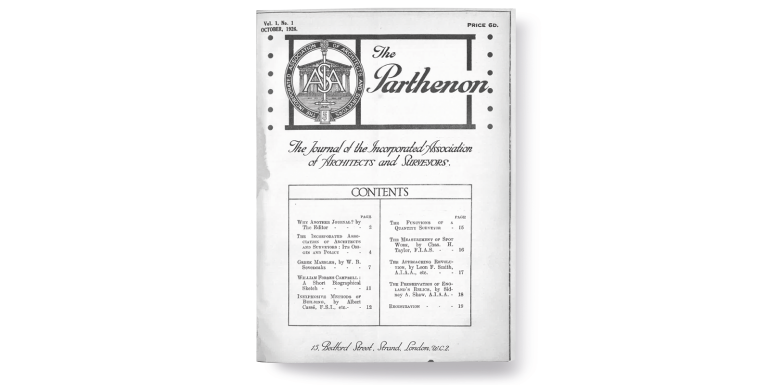
In 1926, The Parthenon was created to amplify the Association’s members’ voices. In this, CABE’s centenary year, Building Engineer has looked back over nearly 100 years of the journal.
It is a testimony to the resilience of CABE to be able to evolve and adapt with the changes over the past 100 years. In 1925, the Incorporated Association of Architects and Surveyors (IAAS) was formed to champion inclusivity and fair representation, to give a voice to those outside traditional institutions and to ensure reform didn’t mean exclusion. In 1993, the IAAS became the Association of Building Engineers and, in 2014, it was awarded the Royal Charter to become the Chartered Association of Building Engineers. The values that were behind the initial creation of the IAAS remain with us.
October 1926
The journal’s first issue sets out its stall: “To bring together … all the members scattered over England, Scotland, Wales, Ireland and the Dominions [who] could never be present together at a lecture, a dinner or branch meeting … a journal would provide the necessary medium for the exchange of ideas, the formulation of policies, the dissemination of technical matters – and even the airing of grievances.”
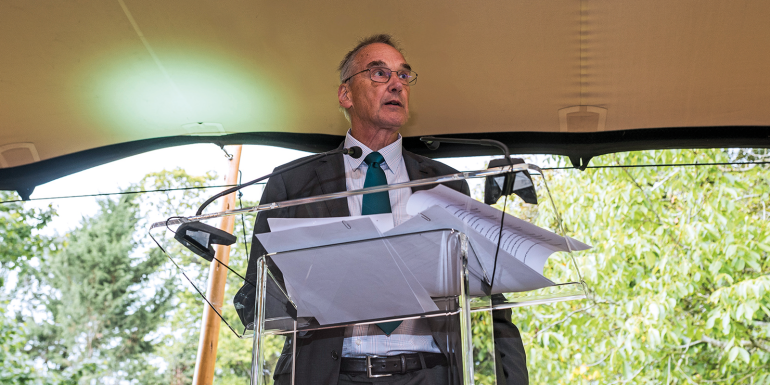
CABE Patron Lord Lytton
August 1935
Published four years from the start of World War II, the journal discusses plans for an IAAS delegation to Italy for a conference and celebration of architecture. In later publications, it notes that the delegation was greeted by Benito Mussolini. With legendary architect Sir Edwin L Lutyens as President, the journal discusses how the role of architect has started to incorporate more engineering requirements and expertise.
July 1945
World War II was ongoing and the issue covers new building in ‘blitzed’ parts of London, as well as concern at the lack of professionals to support rebuilding efforts and what state the architects and surveyors serving in the forces will find their industry in upon their return.
The theme of competency and professional excellence runs throughout, with members quoted: “To protect the public and … ensure that all the registered persons were competent to practice their profession”; “it could rightly be said that a man whose name is on the register is a man who has been scrutinised very carefully as to his qualifications to act.”
June 1955
The Association welcomes a new coat of arms and decries “the way in which the country in general – and the urban part of it in particular – is exploiting the opportunities for redevelopment that the ravages of war opened up”. This theme of poor-quality design and building is prevalent in subsequent issues.
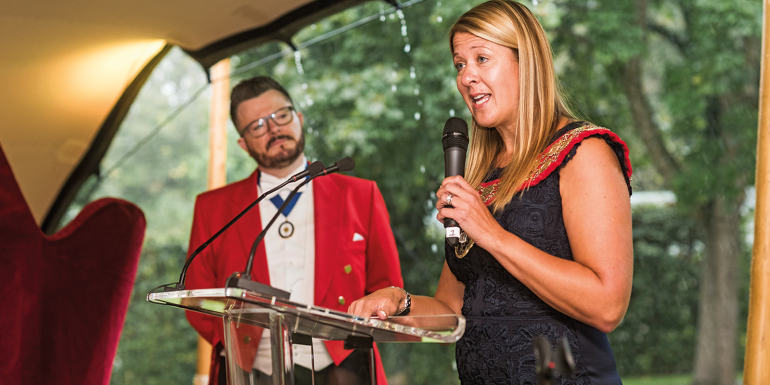
CABE President Zoe Cox
May 1965
Ten years later the theme continues: “At the end of this century, the population of Great Britain is expected to rise from 52 million to 72 million … [a] vast amount of development will be necessary to cope with this increase in numbers and the radical environmental changes that will be involved for us all.” A short piece notes that the IAAS had sent a memorandum to the Parliamentary Secretary of the Ministry of Housing and Local Government to state that “municipal building surveyors and inspectors are best qualified for the task of stamping out jerry-building [the act of building with cheap materials] where such exists”.
April 1976
President Denis Walker’s address encourages the 5,000-strong membership to be generous in their knowledge and use the Association as a network to share their expertise with their peers. Technical articles have been prevalent in the journal, and this issue covers the relatively new phenomenon of heat pumps – included because of significant member interest in a presentation on ‘Using and saving energy’ at the annual conference.
March 1985
This issue is all about energy conservation – from basic insulation techniques to low-energy housing developments and the establishment of the Building Research Establishment’s Building Research Energy Conservation Support Unit to support the Department of Energy with demonstrations of energy-saving methods.
The President’s inauguration address covers the emergence from the Building Act 1984 of “the supervision of building works other than by local authorities”, noting that those working in the private sector have the opportunity to become “approved inspectors” for building control.
February 1995
The President was Robert Biggs, who many will know from his current involvement in the Benevolent Fund. The issue calls for members to pay heed to their CPD and professional competency frameworks. A piece from the Health & Safety
Commission covers “new regulations aimed at improving the health and safety standards in the construction industry”.
January 2005
Both the Scottish Building Standards Agency and the idea of clearly defined roles and responsibilities emerge in this issue. The edition also features the Association for Specialist Fire Protection talking of the need for ‘Responsible Persons’ and the introduction of Home Information packs requiring “qualified and independent personnel [to] carry out the certification of buildings” in the form of home inspectors.
January 2015
President Michael Wadood notes with pride that CABE is setting standards of competency and professionalism. Chief Executive John Hooper says: “Often considered to be punching above our weight, it is encouraging now that, as a Chartered Association of Building Engineers, our views and expertise are being called for to help shape the future of the sector – and that building engineering is recognised as a profession, with leading organisations now describing their work as building engineering.”
Digital archive
A digital archive is being created to preserve CABE’s rich heritage, making its historical publications and records accessible to members and researchers alike. This resource will enable people to explore CABE’s contributions across the decades, key moments from conferences and industry collaborations, as well as how building engineering has evolved in response to technological advancements, regulatory changes and the needs of society.
The online collection will enable access to the Association’s technical journal from its inception as The Parthenon through to its current iteration Building Engineer. Each journal serves as a historical marker capturing the history of the Association and the wider construction industry.
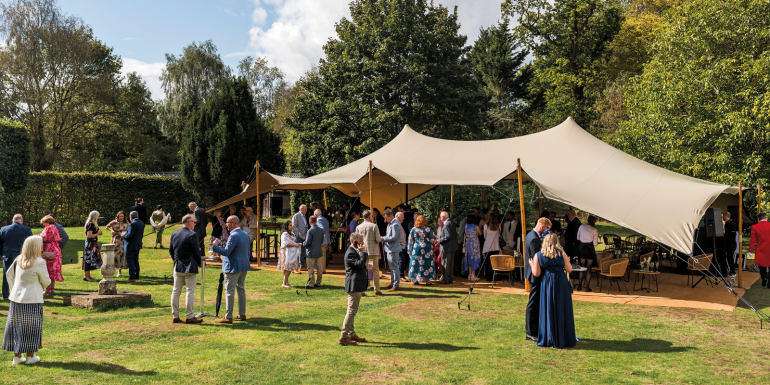
The great and the good of CABE celebrated the centenary with a garden party at Stanbrook Abbey in Worcester in September
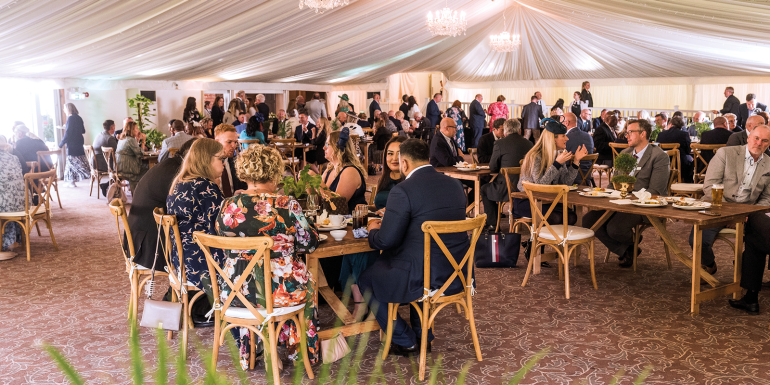
The centenary garden party
In September, the great and the good of CABE gathered to celebrate its 100 years. Even the torrential downpour couldn’t dampen the spirits! CABE’s values of collaboration, responsibility, progression, rigor and trustworthiness were evident in every part of the day, from the exhibition of the Association’s history to the rousing speeches. These principles of upholding ethical conduct, maintaining competence, adherence to professional codes and promoting high standards for public safety and sustainability through collaboration and the sharing of knowledge will stand CABE in good stead for the next 100 years.
Image credit | Paul Mockford | CABE
Related Content

Jobs

Permanent
Senior Quantity Surveyor- Civils/ Power
Permanent
Quantity Surveyor

Permanent
Assistant Quantity Surveyor
Permanent