

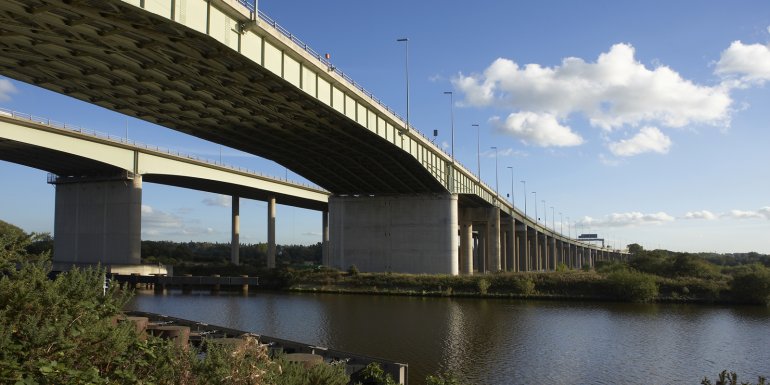
A major UK road bridge that plays a strategic role as a diversion route for a key motorway has been found to have almost all of its bearings in a severe state of deterioration after more than 15 years of unnoticed degradation, according to a new safety report published by the Collaborative Reporting for Safer Structures UK (CROSS-UK).
The deterioration was only uncovered in a recent inspection, raising serious concerns about current inspection regimes, asset management expertise and funding priorities for critical infrastructure.
The anonymous reporter who filed the CROSS-UK Safety Report (ID 1480) highlights that bearings — which are essential to facilitate thermal movement and transfer loads safely in bridge structures — were found to be severely compromised. Pier heads showed signs of cracking and the bearing plinths were badly cracked, signs that could indicate uneven load distribution or settlement with potential to undermine the bridge’s structural integrity. Because the bridge is heavily relied upon, particularly when nearby motorways close in winter, the risk of closure or operational restrictions carries the possibility of major traffic disruption and economic impacts for freight, commuters and local businesses.
The reporter noted that the deterioration went undetected despite principal and post-tensioned inspections carried out as recently as 2021, and that the issue only came to light after the local authority appointed a staff member with relevant technical experience. They attributed the failure to spot the signs earlier to a lack of technical expertise and a severely constrained maintenance budget, concerns echoed by industry practitioners who emphasise that robust, risk-based inspection frameworks are essential to prevent latent defects becoming critical safety issues.
The report draws attention to past costly interventions, pointing to cases such as the Thelwall Viaduct bearing replacement programme (pictured above), which ran into tens of millions of pounds in costs, to illustrate the scale of financial exposure when ageing infrastructure is allowed to degrade. Analysts say the case highlights a broader trend of deferred maintenance due to funding shortfalls, where investment has often been directed toward cosmetic fixes like road surfacing rather than risk-based structural safety work.
CROSS’s expert panel welcomed the timely report, stressing that effective and sustainable asset management is critical to ensure the safety and longevity of infrastructure. They warned that without adequate funding, competent inspection, planned maintenance and transparent risk assessment, isolated defects can escalate into potentially catastrophic failures that are costly and dangerous to address.
Related Content


Jobs

Permanent
Senior Quantity Surveyor- Civils/ Power
Permanent
Quantity Surveyor

Permanent
Assistant Quantity Surveyor
Permanent