

This report involves a cladding and building remediation project on an HRB that was fraught with challenges and, crucially, says the reporter, where residents’ voices were not heard or considered. As a result, residents may continue to harbour concerns about the safety of their building. Some significant safety risks are said to remain unresolved. There were a number of issues during the process – this report focuses on one of them.
As part of the works, new doors were installed onto balconies, which resulted in a raised threshold being added to existing doorsteps. The change in section involved adding door frame bottom members and a projecting external cill to create an upstand in the middle of what was previously a flat-topped step. The change to the step is shown diagrammatically in Figures 1 and 2.
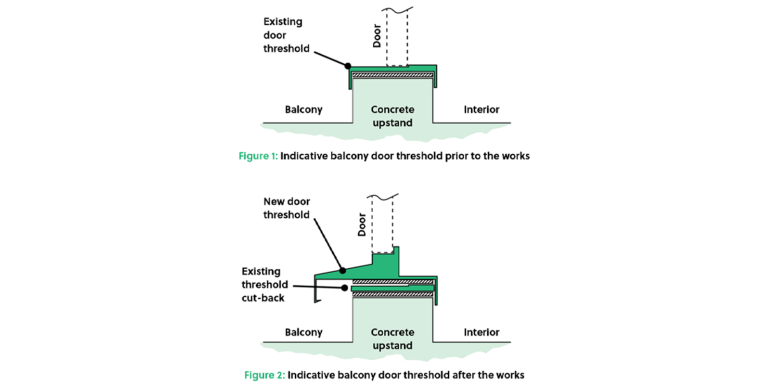
Prior to the refurbishment, residents reported often sitting on the flat step, leading from the kitchen to the balcony, and socialising with whoever was in the kitchen. However, the introduction of the new higher threshold not only meant this was no longer possible, but also introduced a trip hazard. There were several meetings between residents, owners and contractors at which residents raised the issue of the trip hazard but, says the reporter, their concerns were not listened to and hence not addressed.
After much campaigning by residents with support from external groups, the owner finally accepted that the thresholds needed to be redone. The revised design will have a lower threshold but still be higher than the original. Of concern is that the residents have been told that this remediation will only be carried out if requested by the occupants of individual apartments. The reporter questions why, if the thresholds are unsafe, they are not all being remediated. In their view a potentially unsafe feature should be universally corrected.
Residents questioned the building regulation implications of raising the threshold height and believed that even if the new height was compliant this did not remove the trip hazard. It took several difficult and lengthy meetings to reach a position where it was agreed that the original remediation work should be redone to improve the newly installed thresholds.
Experiences with the new thresholds have included one resident suffering a fracture when tripping on the step, many residents having caught shins on the top of the step with consequent bruising and many elderly residents no longer being able to use the balcony as it is too high and too wide for them to step over.
Addressing resident concerns is crucial for effective risk management in refurbishment projects and listening can ultimately reduce project costs, avoid rework and minimise compensation claims. Listening to residents is particularly important after the findings of the Grenfell Tower Inquiry.
Key learning outcomes
For HRB owners, Principal Accountable Persons and Accountable Persons:
- residents have in-depth knowledge of the conditions and shortcomings in their buildings, which must be acknowledged
- when residents express concerns about safety, their views should be taken into account when planning and carrying out works associated with or within the building
- it is beneficial to have regular meetings with residents to listen and to engage with them on forthcoming work; and
- be aware of the legal requirements about the concerns of residents in the Building Safety Act 2022.
For professional teams and contractors:
- always recognise the importance of residents’ views when planning works and when carrying them out
- use feedback from residents to improve relationships; and be particularly aware when residents are concerned about fire safety and be prepared to escalate these concerns and take action.
Comments
Residents’ input is critical since they live with these buildings daily and ignoring their concerns erodes trust. Residents should not only be safe, but also feel safe.
The unresolved technical issue appears to be the introduction of a trip hazard between flats and balconies. While this design is not ideal, an upstand is a common feature in existing UK housing. BS 8579:2020: Guide to the design of balconies and terraces gives detailed information about upstands and access requirements. In this context, it should be noted that slips, trips and falls in buildings cause more deaths than fires or structural failures.
Following the Grenfell Tower tragedy, it was rightly determined that residents’ voices must be heard, and safety issues addressed quickly and visibly. When safety concerns are raised, they must be acted upon, and the obligation to engage with any source of safety reports should be emphasised.
Comments suggest that the local authority’s unresponsiveness is already widely recognised and that the report appears to reflect more on internal concerns and management issues than strictly technical failures.
This is an unusual report for CROSS in that it is about people and culture rather than technical issues. However, it introduces an important point relating to structural and fire safety, which is likely to be significant. We welcome other reports on the cultural aspects of safety as part of our commitment to improve safety for the public, those engaged in building works and fire and rescue services.
The premises is a higher-risk building (HRB), so there are mechanisms under the Building Safety Act 2022 for residents to report concerns. However, it appears that these may not be producing the anticipated outcome and in due course the matter may come to the attention of the Building Safety Regulator for a resolution.
This report serves as a valuable reminder that building safety is as much about listening and transparency as it is about technical compliance. It encourages ongoing vigilance and a resident-centred approach, both of which are essential for maintaining public trust and ensuring that safety concerns are addressed before they escalate into major issues.
To subscribe to the CROSS UK newsletter (structural and fire safety concerns), visit cross-safety.org/uk/user/register
Image credit | iStock
Related Content
Jobs

Permanent
Structural Engineer
Permanent
Managing Quantity Surveyor
Permanent
Quantity Surveyor-Civils
Permanent