

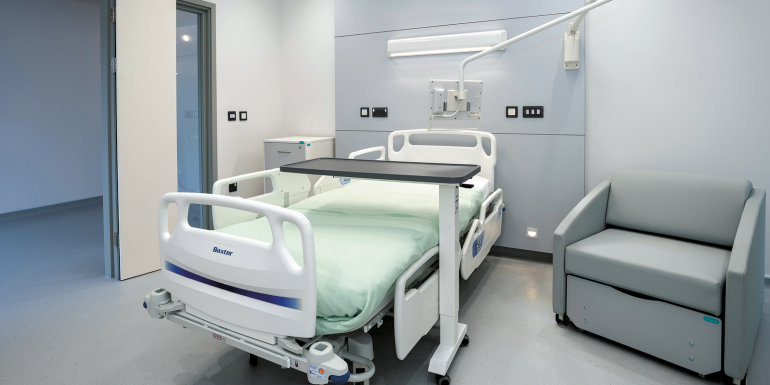
A prototype modular hospital bedroom could be key to the UK government’s multi-billion-pound New Hospital Programme in England, but Scotland has some notes.
The New Hospital Programme (NHP) across England is backed by £15bn of UK government investment over three consecutive five-year waves. Wave 1 schemes are set to begin between 2025 and 2030 (including hospitals that require attention due to reinforced autoclaved aerated concrete). The NHP is adopting a standardised and programmatic approach, using modern methods of construction (MMC), to save time and create facilities that are adaptable, sustainable and clinically tested.
Under the NHP, every new hospital will feature single-occupancy bedrooms. To this end, a full-scale prototype bedroom, ensuite and adjoining corridor was commissioned by the NHP. If approved, the prototype will serve as the standardised bedroom across the entire programme, providing the NHS with an MMC modular solution that accelerates the delivery of the next generation of hospitals.
Developed by Reds10 at its 300,000 sq ft off-site manufacturing facility, the prototype allows the NHP to interrogate the spatial requirements for the bed- and bathroom pod, along with the mechanical, electrical and plumbing connections and adjacent corridor space. The prototype is undergoing clinical testing and the results will be reviewed by ministers, the NHP, NHS and other critical stakeholders, including public and patient forums.
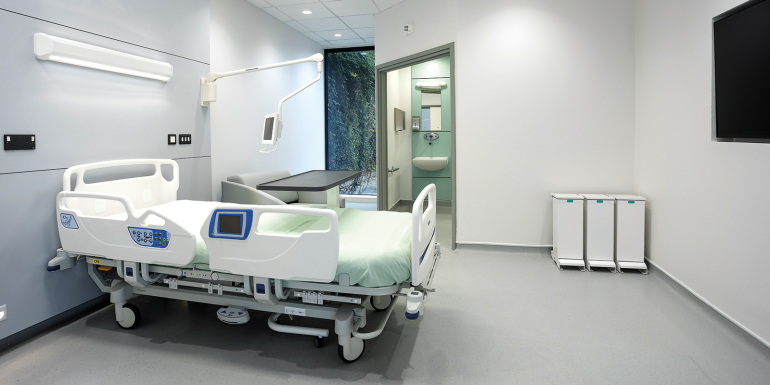
A full-scale prototype bedroom, ensuite and adjoining corridor was commissioned by the New Hospital Programme.
MMC pros and cons
However, England lags behind Scotland, which introduced the policy of single-occupancy bedrooms for the NHS estate in 2008. As such the Scottish government offers some significant lessons from its use of MMC. These include damage during transportation that could mean the design approved in the building warrant is compromised.
It notes that geographical factors will also need to be considered at the product/component specification stage as they may need additional treatment based on where they are being used – such as costal regions – or may require a particular type of installation depending on the building height and exposure.
It states: “For high rise, the more compartments that are stacked on top of each other, the greater the potential risk is for cumulative error if the design and/or subsequent installation is not fit for purpose.”
The government paper also makes an important point about fire safety, namely that MMC building has “typically greater occurrence of voids and cavities through which smoke and fire could travel rapidly if not adequately controlled”.
It says: “Individual components and products are subject to testing, but ... may not have been tested comprehensively to consider how a full system or module performs (in the event of fire; structural resilience; energy efficiency etc). There is no mandatory requirement for performance testing of individual panels or full modules. Standard fire testing and approaches typically assess individual details and do not test connections ie how one module is connected to the floor. Volumetric systems are not tested in their entirety in a way that takes the height of the building into account.”
So while the standardised approach offers great efficiencies and opportunities to interrogate the units before use, it’s also vital not to lose sight of holistic thinking simply because these are individual units. Using the advice from what has gone before can only improve the prototype.
For more, visit reds10.com
For the full set of learnings from the Scottish government, visit b.link/ScotGOV_MMC
Image credit | Steph Simmons
Related Content

Jobs

Permanent
Senior Quantity Surveyor- Civils/ Power
Permanent
Quantity Surveyor

Permanent
Assistant Quantity Surveyor
Permanent