


Denise Chevin meets the lecturers who are outsmarting AI to show students that the appealing shortcuts on offer will only shortchange them in the professional world.
In lecture halls across the UK, universities are grappling with a quiet revolution: the rise of generative AI. What began as a curiosity – a chatbot that could summarise an article or draft a polite email – has quickly evolved into something capable of producing fluent essays, generating design concepts, drafting risk assessments and even suggesting structural calculations in seconds.
For built environment disciplines, the implications are particularly sharp. Architecture, surveying, construction management and engineering are not purely academic pursuits; they are gateways to professions where judgement, accuracy and accountability matter. A degree signals that a graduate can think critically, interpret regulations, evaluate risk and make decisions with financial and sometimes life-safety consequences. If too much of that intellectual labour is quietly outsourced to an algorithm, what exactly is being assessed?
Across the sector, educators acknowledge they are playing catch-up – but they are converging on a pragmatic position. The problem is not that students use AI. The problem is when they cannot function without it.
So how are they striking the right balance between encouraging its use and producing AI-literate graduates, and preventing them from outsourcing thinking and learning?
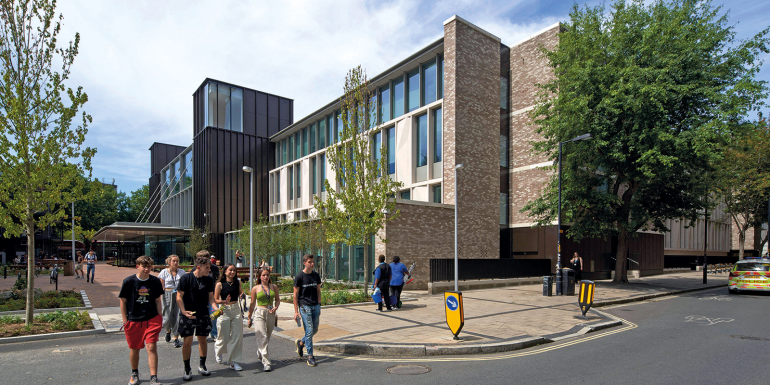
Building institutional frameworks: London South Bank University
Recognising the need to ensure students retain their powers of critical thinking is central to how lecturers in the built environment at CABE Academic Partner London South Bank University (LSBU) are dealing with AI use.
Lucia Otoyo, Associate Dean for Quality in the College of Technology and Environment and Chair of LSBU’s AI working group, describes a co-ordinated approach. “We provide guidance across the university, but module leaders must incorporate it into their specific courses. For instance, architecture students use AI differently to law students. The principle is the same: support learning while safeguarding integrity and fairness,” she says.
Data security also forms part of the university’s AI framework, explains Otoyo. “LSBU licenses Microsoft Copilot, meaning information entered remains within the institutional environment. Staff and students are advised not to input personal or confidential data into public systems.” Transparency extends to academics themselves: where AI supports marking or feedback, its use should be acknowledged.
How students can be prevented from misusing AI
Tactics that academics in the built environment are adopting
- Giving specific assignments: Assignments are being redesigned to be case-study based or tied to niche scenarios. Generic questions are easily answered by AI; detailed briefs reduce inappropriate use.
- Providing clear AI guidelines: Like Nottingham Trent’s Chris Keast, include a traffic light system with every coursework brief. Clearly state what AI can and cannot be used for, encouraging ethical engagement rather than blanket bans
- Holding viva and presentation checks: Require students to present or defend their work orally. If they cannot explain their submissions, it may indicate misuse. Some architectural schools are even going back to hand drawing
- Securing AI use: Direct students to licensed or approved AI platforms when handling sensitive information. Avoid public tools for work involving real client data.
- Adopting project-based learning: Embed assignments in authentic, real-world contexts that demand observation, interaction and critical thinking beyond AI output.
- Holding regular check-ins: Tutor reviews help confirm that AI is supporting learning rather than replacing it.
- Spelling out the consequences: Highlight real-world consequences of AI misuse, including risks to safety, accuracy and ethics.
- Teaching core principles first: Students should demonstrate understanding of fundamentals – such as calculations, survey methods and design basics – before using AI to enhance their work.
Supplementing, not supplanting, learning
Her colleague, James Bishop, Senior Lecturer in the built environment at LSBU and Course Leader for undergraduate and apprenticeship programmes, notes the importance of instilling foundational knowledge before students rely on AI. He illustrates how this translates in construction management courses. “It’s about making sure students understand the principles. If they’re using AI, they need to have the skills to assess accuracy.” He highlights that covering core industry knowledge – such as health and safety and building regulations – ensures that AI supplements learning rather than supplanting it.
Both emphasise that AI literacy is a professional imperative. Bishop says: “We’re encouraging the use of AI in the right way because students will need this understanding in professional life.”
Assessment practices at LSBU have evolved. There has been a move away from long end-of-module exams towards a broader mix that includes time-constrained assessments under supervision.
Both Bishop and Otoyo are conscious of avoiding misuse of AI in coursework. Submissions require students to declare how and to what extent they have used AI. If they suspect ChatGPT has been left to do the homework, greater scrutiny follows.
Detection software is not treated as decisive evidence. Instead, markers look for depth, technical precision and independent thinking. Overly generic responses or a lack of critical engagement raise red flags.
“We cannot rely solely on detection software. The key is assessment design that tests knowledge and critical thinking. Uncritical use of AI must not lead to passing grades,” says Otoyo.

Sarah Davidson: Creating a safe space to critique AI at Nottingham
As Professor of information management in the Department for Architecture and Built Environment at the University of Nottingham, Sarah Davidson has a particular interest in how AI is shaping professional practice.
“AI is advancing so rapidly. We want our graduates to be ready for the workplace, and that means they need a degree of AI literacy. But we also need them to develop their own critical thinking.
“Employers are going to want people who can use it responsibly, who understand its limitations and who can critically reflect on the responses it generates.”
The school is developing a more nuanced framework. In some assessments, students are encouraged to use AI as part of the learning outcome – for example, when the aim is to understand how to integrate digital tools into workflow. In others, where the goal is to build independent research or analytical skills, students are explicitly told not to use it because the course is intended to help students develop their own thinking and critical reflection skills.
One of Davidson’s most effective teaching tactics is to bring AI into the classroom and interrogate it openly. She asks students to pose the same technical question to tools such as ChatGPT, Gemini or Claude, then collectively dissect the answers. “You can create quite a safe space to have a discussion. You’re not critically reflecting on the student – you’re concentrating on the response.”
The exercise often reveals subtle inaccuracies or superficial reasoning. “You can show where the information being returned isn’t quite right and why it’s not quite right. That develops a critical approach to responses.”
Davidson points to industry concerns about practitioners relying unthinkingly on automated calculations. The risk is not just inefficiency but unsafe outcomes when outputs are accepted without sense-checking.
Manual activities replaced by technology
Alongside this, Nottingham is embedding more explicit teaching around data fundamentals: the distinction between data and information, how data structures work and how information can be manipulated responsibly.
“If a student has a basic understanding of how AI works, they can start to understand the risks and the benefits, rather than just seeing it as something you type into and get an answer back,” Davidson says.
So, is AI transforming the built environment workplace? “I think it has been changing for a while,” she says. “There are definitely manual activities that can be replaced by technology.”
Drawing on her experience as a Quantity Surveyor, she offers a practical example. “There was never any particular value in me being able to measure a straight line. If a computer can do that more quickly and accurately, let the computer do that.” The value lay elsewhere: advising on risk, interpreting market conditions or understanding pricing dynamics. AI, in her view, should do the same.
“We don’t need to see change as negative. We need to look at how it frees us up from more mundane activities and gives us the space and time to do things that are really valuable.”
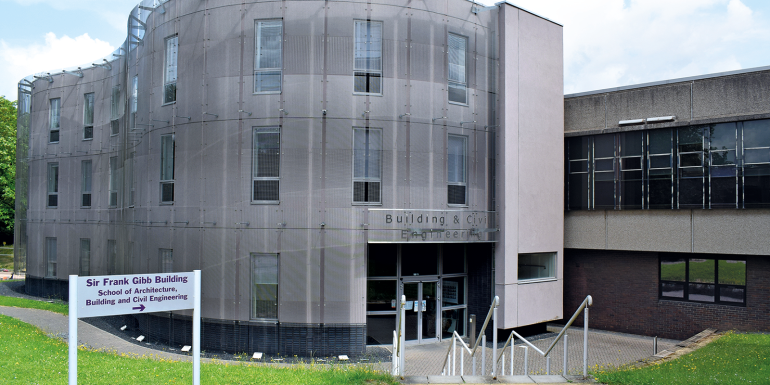
Process and professional reality at Loughborough
Dr Karen Blay, Senior Lecturer in digital construction and quantity surveying at Loughborough University, stresses the importance of process.
AI can suggest alternatives aligned with client requirements, expanding creative exploration and improving efficiency. But Blay is unequivocal: students must first produce something themselves. AI can refine and iterate; it should not originate their thinking.
Blay sees this as symptomatic of a broader ‘input-output’ culture shaped by digital immediacy. She says: “Students accustomed to instant responses may prioritise polished answers over understanding how those answers are constructed. Yet in professional practice, process is where accountability lies.”
Setting the standards for CABE
Peter Dawber, Chair of the Recognition Board at CABE and an external verifier across construction and building safety programmes, sees the issue not just as an academic question but as one of standards and public trust. Dawber is a former academic himself – the Dean of Nottingham Trent University’s School of Architecture, Design and the Built Environment and now an education consultant.
As an external examiner, Dawber samples student work to ensure marking is fair and that courses meet professional expectations. In recent years, he has noticed more assignments flagged by AI-detection software. These tools, similar to plagiarism checkers, attempt to identify text patterns associated with large language models.
But they are far from definitive and, for Dawber, software can only ever be a prompt for closer reading, not proof. As an assessor, human judgement remains central.
When something feels off, he looks for contextual clues: American spellings in a UK regulatory discussion, imperial measurements where metric would be expected or generic phrasing detached from the specific brief. More commonly, the issue is not outright inaccuracy but superficiality. The answer may be broadly correct, yet strangely non-specific.
Dawber resists talk of crisis. Coursework warehouses and bought essays have existed for years. The difference now is accessibility. “It’s free to use and much more sophisticated than anything we’ve had before,” he says. “That’s where it’s a bigger concern.”
He also points to structural pressures. Larger cohorts and reduced contact hours make it harder for tutors to know their students well enough to spot sudden leaps in written quality. “If you knew your students and they suddenly submit this wonderful piece of work, alarm bells would ring,” he says. “The more remote we get, the harder that is.”
For Dawber, the first principle has to be clarity. “Universities cannot penalise students for using tools they were never told to avoid. Policies must explicitly state what is permitted and what is not.” Even seemingly innocuous aids such as grammar-enhancing software raise questions about where assistance ends and authorship begins, he says.
Ultimately, he believes the answer lies in transparency and the design of the questions. “Be clear what they can and can’t use before they start. If the task is framed too generally – ‘design a typical floor joist’ – AI will produce a textbook-style response.”
He underscores the need for students to be taught to use AI, likening it to Excel or a sat nav. Both enhance productivity; neither replaces professional judgement. “A sat nav suggests routes but cannot know your priorities. A spreadsheet performs calculations but cannot tell you if the inputs are flawed. The risk, as ever, is ‘rubbish in, rubbish out’.
“For employers, that distinction matters. Graduates who can use AI to accelerate data gathering or generate options are valuable. But only if they can interrogate outputs, integrate client needs and recognise when something does not stack up.”
Informed application over blind reliance
To counteract over-reliance on AI, Blay designs process-driven activities, such as projects based on site visits. “In that way, you can’t use AI to do that. It’s about having activities that force students to physically participate without using AI for things. And that is mainly to help them be process-driven rather than just input an ask and expect an output. Because the process is what brings out that critical thinking.”
She also teaches first principles. “We still teach students how to do things from first principles. Because if you don’t know about the first principle, you can’t sense-check the outputs that you’re receiving.”
Legal and ethical dimensions are part of the teaching as well. She explains to students that “using AI on live client projects may require explicit permission, particularly where sensitive data is involved”. Blay also highlights referencing issues:
AI-generated text can fabricate or misattribute sources.
Her own research applies AI in defect detection using photogrammetry, including projects in healthcare contexts. As Blay points out: “The distinction is not between using and rejecting AI, but between informed application and blind reliance.”
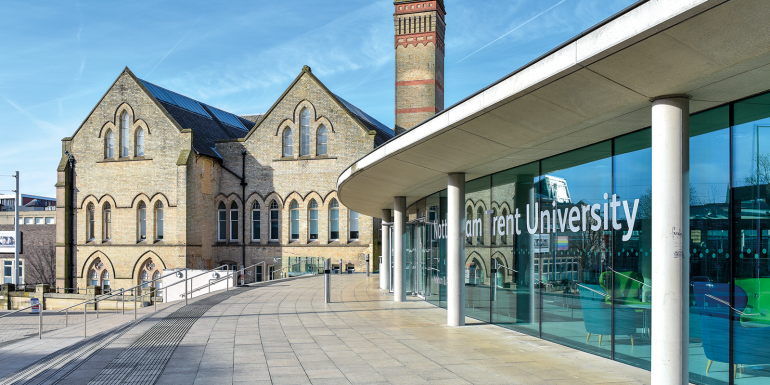
Preventing shortcuts at Nottingham Trent
Chris Keast, Principal Lecturer in the School of Architecture, Design and the Built Environment at CABE Academic Partner Nottingham Trent University, oversees postgraduate and degree apprenticeship programmes in property management, development and building surveying. His courses are accredited by CABE and he is Chair of the East Midlands CABE Committee.
He is clear that AI is not a passing trend. “I had a conversation with our external examiner recently who said any surveyors not using AI won’t have a job in ten years. You’ve got to understand its possibilities – and its dangers.”
For Keast, the key challenge is ensuring students don’t mistake AI as a shortcut to good grades, while acknowledging its legitimate use.
In project-based modules, students might generate design ideas or mood boards using ChatGPT or Microsoft Copilot. “If students visit a building and take photographs, they can use AI to rework the interior or exterior to create visualisations for the client. That’s a really good use – it enhances the client experience and is responsible use.”

Encouraging ethical engagement
However, the risk is over-reliance. “We saw, with a law coursework example, that if you put it into an AI system, it would give a very good answer – but it would not be the student’s own critical thinking,” Keast notes.
His department responded by redesigning assignments to be harder for AI to tackle inappropriately, issuing an AI traffic light system with every brief. This clarifies what students can and cannot use AI for, creating boundaries while encouraging ethical engagement.
Keast emphasises transparency and accountability. Students must be able to justify their outputs in vivas or presentations, often in front of clients, academics and peers. “If it’s not your work, you can’t answer questions – that becomes immediately obvious.”
Keast also highlights the importance of using proprietary or secure AI tools when dealing with sensitive client data. He says: “The external industry is moving towards bespoke AI assistance. Once you put something in generative AI, it’s in the public domain. Students need to understand that – where data is sensitive, they must use their own Copilot or secure software.”
Like other academics interviewed, Keast designs assignments that require sustained thinking. One project is with a local organisation helping with a sustainability initiative. Students work with the authority’s facilities management team, learning the site’s specifics and sustainability goals. Their task: develop bids for central government funding and produce a sustainability report.
Students visit the site, gather data and collaborate in groups. Each student writes an individual report while contributing to a group presentation delivered to clients, including the authority’s sustainability manager and local council representatives. “This is real-world context,” Keast says. “They must present findings and answer questions they can’t prepare for in advance. It ensures the work is genuinely theirs – students can’t bluff their way through.”
LSBU and Nottingham Trent University are CABE Academic Partners – find out more here.
Image credit | iStock | Alamy | Shutterstock
Related Content


Jobs

Permanent
Senior Quantity Surveyor- Civils/ Power
Permanent
Quantity Surveyor

Permanent
Assistant Quantity Surveyor
Permanent