

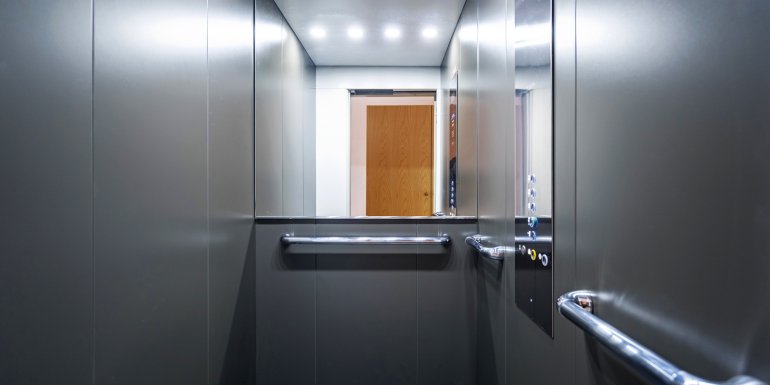
Rachel Smalley FCABE C.Build E, an NRAC-registered Inclusive Design Consultant and Director of Inclusive Design at Jacobs, urges lift design, specification and provision to consider the end users.
Recently published standards have catalysed a lot of discussion about the use of lifts, including the use of lifts in emergency egress situations. But how much of this discussion has considered the users of lifts?
It is very easy to consider lift provision as an engineering solution, involving calculations, modelling and assessments. However, it is important to remember who lift users are, how they experience the built environment and what their requirements are. Doing so is the only way to ensure that user functionality is baked into lift provision and design, and that they are people-focused, usable, relevant and future-proofed – that they work for the people who rely on them. So, who do we need to be thinking about?
In terms of people who require the use of a lift, most people probably think of wheelchair users. This is understandable – the international symbol for disability is the wheelchair user symbol, and it is one we probably all see many times each day on parking bays, in toilets and to indicate ‘accessible’ facilities.
‘Approved Document M: access to and use of buildings, volume 2: buildings other than dwellings’ says that “for all buildings, a passenger lift is the most suitable form of access for people moving from one storey to another”. But it goes on to explain: “In exceptional circumstances in an existing building, a wheelchair platform stairlift may be considered, provided its installation does not conflict with requirements for means of escape.” This is likely to reinforce the strong link between wheelchair users and a certain type of lift for those reading it.
The link between lifts and wheelchair users is embedded into our thinking on a daily basis through many sources. However, it should be questioned how accurate the assumption is that lifts are mainly installed to meet wheelchair users’ requirements.
According to an analysis of the Family Resources Survey (2022-23), only 11% of disabled children and 23% of disabled adults in the UK use wheelchairs (and not all of these will be ‘full-time’ wheelchair users). These are, for some people, surprisingly low percentages. But from this point is it worth questioning what other groups of disabled people require the use of a lift?
Who are lift users?
The fact is that many disabled people, with a range of impairments or conditions, require or rely on the use of a lift for vertical transportation. This includes (but is not limited to) people with ambulant mobility impairments, some people who are blind and partially sighted and people with certain health conditions.
Beyond the characteristic group of disability are other end user groups potentially impacted by the provision of lifts in the built environment. People who are pregnant or with very young children may require the use of a lift, as may some older people with age-related impairments or people who wish to avoid using stairs but who do not identify as disabled.
Some of these groups’ requirements relating to lift usage may vary by level change. For example, some people with ambulant mobility impairments, certain health conditions or who are pregnant may not require or rely on the use of a lift for a single-storey level change, but would for two to three storeys or more. Level of ‘need’ for a lift (including in an emergency egress situation) therefore increases as level change/building height increases.
Simply considering the ‘need’ for lifts in buildings in terms of wheelchair users is thus not accurate. Relying on wheelchair user statistics for capacity assessment purposes, including in emergency egress situations, can result in built environments that do not meet the requirements of building users. It also potentially does not meet the functional requirement of the Building Regulations to make reasonable provision for means of escape in the case of a fire and for everyone to use buildings, including disabled people.
It is important that built environment professionals consider a broader range of potential lift users other than people who are wheelchair users. Thinking more broadly about end users and responding to their requirements will result in design features being provided that positively effect on the usability of lifts for other end user groups – for example, suitable tonal (light reflectance value) contrast for people who are blind or partially sighted, or two-way communication devices with screens benefitting people communicating via sign language or lip reading.
Important standards
Recently published standards include:
- BS 9991:2024 Fire safety in the design, management and use of residential buildings. Code of practice
- BS EN 81-76:2025 Safety rules for the construction and installation of lifts. Particular applications for passenger and goods passenger lifts. Evacuation of persons with disabilities using lifts; and
- CIBSE Guide D: Transportation systems in buildings (2025).
Flawed calculations
There is some irony in the fact that internal lift car capacity of ‘x persons’ in the UK is based on a set of assumptions of a person who has a UK average weight of 75kg, a UK body area index of 0.21 and a UK personal space ellipse 600mm x 450mm (0.21m2), and is male. Yet many of the groups listed above – in particular wheelchair users, people using other mobility aids and people who are pregnant – are unlikely to ‘fit’ these assumptions.
So, when considering lift provision, design and specification, please do consider people. Consider who lift users are; the diversity of people who require lifts for access; emergency egress purposes; and how people use and experience the built environment. Doing so and responding to people’s specific requirements is essential to ensuring that user functionality is baked into lift provision and design. This ensures that lifts and the places and spaces they serve work for people.
Image credit | iStock
Related Content


Jobs
Permanent
Senior Building Surveyor / Manager

Contract
Quantity Surveyor

Contract
Senior Structural Engineer - Contract
Permanent