

Iain Cox, Chair of Business Sprinkler Alliance, asks if fire safety is in a sustainability blind spot as engineers try to balance many competing factors.
The built environment continues to evolve; this includes discussions on materials, systems, layouts and indeed the reuse of buildings. With the built environment contributing a significant amount to the UK’s total carbon footprint, there is no question that the sector needs to act to ensure buildings meet their sustainable development goals.
However, terminology and language have changed – they have started to form a new set of almost ‘accounting principles’ for carbon that govern design and material selection and choices for a project. It’s part of a broader framework that’s happening globally, and it threatens to reduce focus to only selected dimensions of a problem rather than the whole entity. For example, is there enough consideration of the sustainability impact from potentially catastrophic risks such as fire?
There appears to be a growing tension between the demands to be more sustainable and the impact on fire safety. You cannot stray too far into the world of fire safety without running into discussions on construction methods, photovoltaics and energy systems. In the background is a growing concern that what is built today remains within the built environment for the next 30-40 years and remediation is not palatable. One only has to look at what has happened with cladding to understand why it may be unviable.
There is also ongoing discussion on the pace of innovation, which doesn’t necessarily include the considerations of the impact of fire upfront, or perhaps the wider impacts of change. These are all indicators of the challenge to balance multiple, emerging needs with fire safety.
Hand in hand
Taking a step back to look at the broader definition of sustainability in relation to environmental, social and commercial aspects, there is an overlap to fire safety. Fire has an impact in all these areas, and working to minimise them through fire prevention and protection has always been seen to be strongly aligned with sustainability.
To date, rating systems, government incentives and regulations change to recognise new measures of sustainable performance to drive market behaviour. The new forms of ‘accounting’ for the use of carbon are well aligned with these principles. That said, if you look at the consequences of a fire in buildings with such ratings, you realise that these sustainability credentials do not account for the effects of fire.
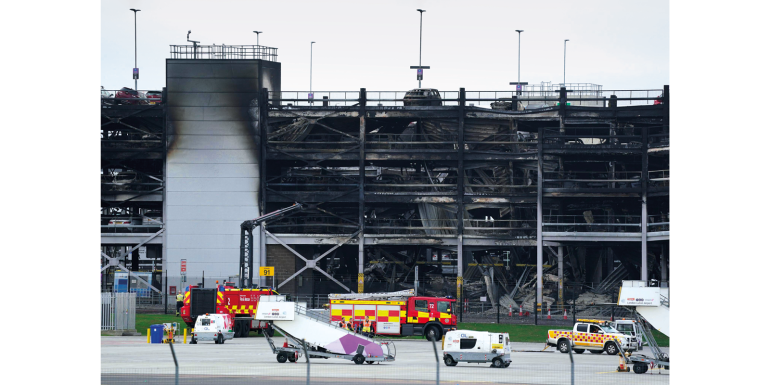
There is a debate to say that sustainability credentials should be separate to fire safety. One is elective and the other is a matter of regulations. However, to the person in the street that does not make sense. Consider the recent large fire at London Luton Airport (LLA) that destroyed a car park and 1,100 cars, and took extensive resources in terms of firefighters and water to contain.
One can quickly find announcements that the car park is to be rebuilt, the cars are insured and will be replaced and, unnoticed, the water will be replenished. The materials from the demolished car park will be recycled as best they can, and I am sure that the scrapped cars will go a similar route. However, stop and think about this from a ‘carbon’ perspective. LLA’s 2024 sustainability report only counts the carbon from “the emissions originating from the demolition waste and fuel used in the deconstruction of the car park structure itself” – not its rebuilding. This will still be tens of thousands of tonnes of carbon equivalent in those new cars and the materials for the new car park. An intelligent estimate would place the carbon component to be equivalent to four years of the greenhouse gas emissions the airport claimed in running operations in 2023 or over 10% of the reported total carbon emissions for 2022.
Let that sink in – that one event has not just cost money, disruption and stress to a lot of people, it also has an impact on the carbon emissions for the airport, and not a minor one. However, the sustainability report also states that the waste and fuel from the demolition “is a reportable scope 3 measure covering the emissions from the LLA infrastructure asset demolition waste only”. This means that because the accounting principle for the emissions in the carbon economy excludes them, it’s saying we can treat them as though they did not happen.
To that effect, only the demolition made it into the accounting of greenhouse gas emissions associated with operations in the LLA annual accounts to the end of December 2024, though there was an entry of £41m of business interruption recovery from insurers for the event.
What does sustainability really mean?
Fundamentally, one could question how sustainable the original project was when one considers the impact of fire, how the issue of fire could be addressed and whether fire should be more of a factor in that measure of sustainability.
My fear is that this is a blind spot; we believe someone else is taking care of it, but really there is a gap. However, this is a little more challenging as some of the decisions that may address it are being overlooked because our eyes are focused on other matters. Let me explain – adding automatic sprinklers as a key part of the fire strategy may be viewed as a negative outcome based on the carbon accounting principles. They bring additional carbon to the project, and that is simply a burden that could be removed with an accrued benefit. However, longer-term this may not be the best decision as the airport example shows that the repair and replacement of fire-damaged properties brings greater carbon use.
It is not a surprise to me that the rebuilt LLA car park will now be protected by sprinklers; the impact of a fire in such a space is all too real now. However, I am still not sure that the blind spot is fully understood.
Fire safety is covered by the Building Regulations, which are currently under review. Isn’t it time that we also reviewed how we define sustainability and considered fire as part of this? The concept of extending life-cycle assessment models to fire has been suggested in Sweden, and perhaps current UK standards could be extended to add some fire-scenario considerations to carbon accounting.
If we are going to successfully green our buildings, safety and sustainability must go hand in hand.
For more information about Business Sprinkler Alliance visit business-sprinkler-alliance.org
Image credit | Alamy
Related Content
Jobs

Permanent
Senior Quantity Surveyor- Civils/ Power
Permanent
Quantity Surveyor

Permanent
Assistant Quantity Surveyor
Permanent