

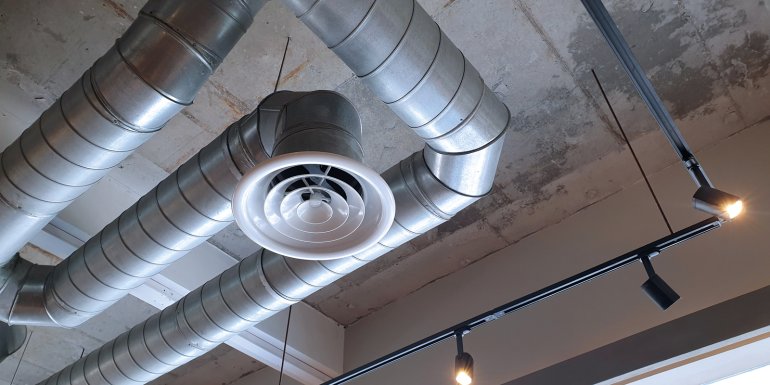
Troy Chambers at Ability by Dimplex explains why specifying fan coil units designed for very low temperatures is vital for future-proofing buildings in a climate of changing carbon regulations.
A drive to reduce the carbon impact of the built environment is leading to wider adoption of heat pumps and low-temperature district heat networks (DHNs) in the commercial sector. However, the shift is having unexpected consequences on established technologies.
This summer, the effects of the climate crisis hit the headlines almost daily. With approximately 40% of UK carbon emissions attributed to the built environment, the construction industry’s focus is on net zero. In 2018, the UK Green Building Council calculated 71% of the built environment’s carbon emissions were operational, while embodied energy accounted for 20%. Since then, legislation such as Part L 2021 has been driving operational carbon reductions through the adoption of renewable technologies, such as heat pumps, for commercial properties. It is expected that this trend will continue following the Future Homes Standard introduction.
As such, embodied energy is expected to account for over half of the built environment’s carbon footprint by 2035. So mechanical and electrical (M&E) consultants must reduce both operational and embodied carbon emissions.
Implications for heat pumps
Traditional fan coil units (FCUs) for heating and cooling delivery are designed to work with flow/return temperatures of 82/71°C for a standard gas boiler or 70/50°C for condensing boilers. To work with heat pumps and low-temperature DHNs, FCUs must deliver services at 45/35°C or below.
As commercial systems shift towards low-temperature heating, many FCU systems rely on workarounds. Air flow increase and additional ancillary coils are some of the strategies that result in oversizing units. This increases noise and system pressures. Oversized units are less energy efficient and increase embodied carbon. Essentially, the operational energy saving gains from the heat pump or DHN could be reduced due to the impact of larger FCUs.
Next-generation FCUs with a re-engineered coil design provide a compact, single-coil solution for very low-temperature hot water. They work by increasing the coil’s surface area to maintain thermal output at lower flow temperatures. The coil is recircuited to reduce pressure drops and pump energy use. Contra-flow design maximises heat transfer efficiency, handling chilled water cooling efficiently and supporting low-temperature heating without extra components or increasing air volume.
Units offer the same operational energy efficiency as standard FCUs and, by eliminating the need for an ancillary coil, reduce components and embodied carbon. Acoustic performance and unit size are unaffected.
Heat-pump-ready FCUs can operate with both boilers and heat pumps, meaning M&E consultants can future-proof systems during refurbishment projects. This helps maintain low embodied carbon levels during subsequent CAT B fit outs or heat pump installations.
Specifying low-temperature-ready FCUs does away with the need to compromise. As a result, M&E consultants can harness the efficiency of heat pumps and DHNs without sacrificing performance, size, acoustic comfort or sustainability. This means that they can meet today’s regulations and prepare for tomorrow’s low-carbon standards.
For more, visit b.link/AP_coil
Image credit | Shutterstock
Related Content
Jobs

Permanent
Senior Quantity Surveyor- Civils/ Power
Permanent
Quantity Surveyor

Permanent
Assistant Quantity Surveyor
Permanent