

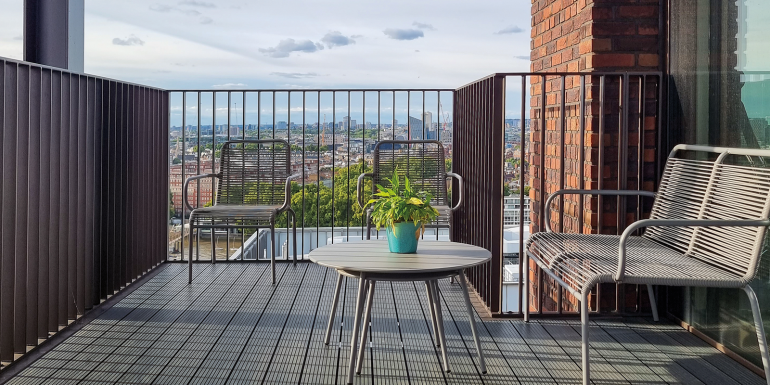
Now that the Building Safety Regulator is under the oversight of the Ministry of Housing, Communities and Local Government, Dura Composites has some notes.
There needs to be an urgent rethink of the UK’s safety regulations relating specifically to decking and cladding for high-rise buildings and how these are implemented, plus tighter rules about fire testing.
There is currently confusion surrounding the exact criteria that different products need to comply with for buildings over the height of 11m. While cladding requires a classification of A2-s1,d0, Approved Document B states that for flooring, a classification of A2fl-s1 should be achieved (see A2-s1,d0 vs A2fl-s1).
However, in practice remedial designers are grouping these two very different products together and requesting an A2-s1,d0 fire classification for all. Unless there is an imperforate substrate under it extending to the full area of the balcony where A2fl-s1 materials are fitted, then A2fl-s1 is allowed.
Lee Cavalier, Decking & Cladding Manager at Dura Composites, says clearer rules and processes are needed. “It’s looking likely the government won’t meet its target to start or complete remedial works on all buildings by July 2027 [in England]. A big factor behind this is the rules themselves, both in terms of clarity over what is required and actually enforcing these standards.”
A2-s1,d0 vs A2fl-s1
- A2 (Limited combustibility): the material, when exposed to fire, will not readily ignite or contribute significantly to the spread of flames
- s1 (Very low smoke production): an ‘s1’ rating means very little smoke is produced during the first ten minutes of fire exposure
- d0 (No flaming droplets/particles): the material does not produce any flaming droplets or particles during the first ten minutes of fire exposure; and
- fl: tested and classified specifically for its fire performance as a flooring material.
Testing requires more scrutiny
In other cases, Dura Composites has concerns that officials aren’t upholding products to regulations stringently enough. This potentially puts occupants in danger and leaves those in charge liable. Furthermore, some decking providers are circumventing the official UKAS accreditation by having products tested in other countries with less strict requirements, before transporting them to the UK.
As Cavalier notes: “When manufacturers aren’t clear on the ratings required for their own products, it’s no surprise that awareness among housebuilders, developers and contractors is low.”
Specifiers can protect themselves by asking the following questions about products, testing and installation for high-rise buildings:
- is the certificate provider UKAS-accredited?
- has every component of the product received a fire rating? Different aspects of a product may perform differently, so there should be a fire rating for each individual component
- do the fire rating and test certificate match the field of application?
- does the installation guide advise on installation methods to match the field of application?
- has each product been installed using a specific method to achieve its stated fire rating?
- has the right orientation been tested? Different orientations may impact the fire rating of the product. Decking products should be tested horizontally and cladding products should be tested in their intended orientation
- have all of the available colours been tested? Different colours of a product may impact its fire rating; and
- does the fire certificate state which colours are covered, specifically in section-4 of the field of application? For example, only a single colour is listed followed by “no variation allowed”.
Dura Composites has submitted its concerns to the Building Safety Regulator and is encouraging other manufacturers to join it in asking for more transparency over fire safety standards for high-rise decking and cladding.
See more at duracomposites.com
Image credit | iStock
Related Content

Jobs

Permanent
Senior Quantity Surveyor- Civils/ Power
Permanent
Quantity Surveyor

Permanent
Assistant Quantity Surveyor
Permanent