

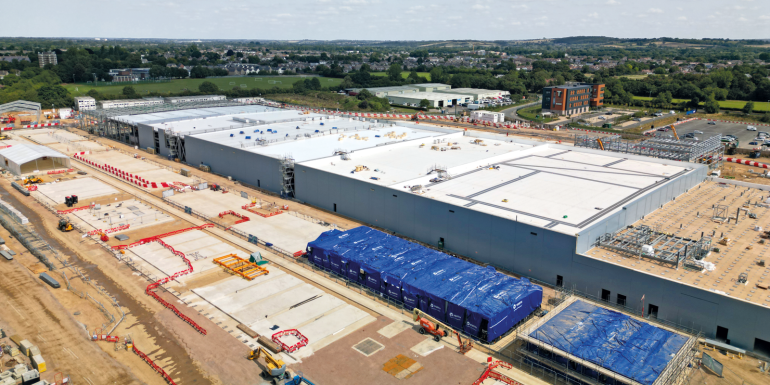
Ciaran Williams, Squire Patton Boggs (UK) LLP, considers the UK data centre briefing paper and the construction boom.
Data centre demand in the UK is expected to triple by 2030, and this will not be met by the expected capacity increase of 15% by 2027. The UK government is well aware of this need and, in August, published a research briefing on data centres, covering the impact and policy issues for the sector.
The report highlights the economic value that the increase in data centres is expected to bring to the UK economy: an anticipated £44bn annual gross value added; £9.7bn in tax revenue between 2025 and 2035; the associated jobs, both in the data centres themselves and importantly in the construction phases; and the potential growth increased data centre capacity could bring to the UK economy, in particular the construction and engineering sector.
The government has stopped short of providing direct financial assistance. Rather, encouragement has been focused on the planning process by removing the hurdles construction projects face. It has:
- designated data centres as part of the UK’s critical national infrastructure
- updated the National Planning Policy Framework, requiring local authorities to consider the need for data centres when setting local policies and making planning decisions
- provided for data centres to opt in to the Nationally Significant Infrastructure Project (NSIP), with streamlined application processes for data centres and approval by the Secretary of State, rather than local authorities; and
- created AI Growth Zones to include a streamlined planning approval process and access to ‘clean power’, with applications open from April 2025 and assessed against capacity, deliverability, local impact and reliance government support.
This may remove some hurdles however, challenges remain, including:
- slow grid connections: there is currently a queue for new grid connections and the new National Energy System Operator Gate 2 project, which provides a priority queue for projects that are ‘ready’ and ‘needed’, does not account for the potential situation that data centres are hampered by the ‘ready’ criteria due to their acquiring of land later in the project timeline than other projects
- skills: 94% of data centre developers and operators report a shortage of experienced data centre construction teams; and
- stretched local planning authority teams: funding constraints faced by local authorities have affected planning teams, as their funding has been cut to fund other critical services.
Types of data centres
Enterprise (on-premises) data centres
Owned and operated by organisations to support their IT operations. These facilities provide complete control over infrastructure security and customisation. Typically, they house critical applications and data that require high levels of privacy and regulatory compliance.
Managing involves investment in equipment, staffing and maintenance to handle the operational complexities of power and cooling management, disaster recovery and equipment upgrades.
Co-location data centres
Offer shared facility space for organisations to host their hardware and servers. This rented space within a facility provides security, cooling, bandwidth, power and support services on a shared basis.
The key advantage is cost-effectiveness, as companies pay for only the space and resources they need while benefiting from the provider’s scale and expertise.
Cloud data centres
Operated by cloud service providers, these offer scalable virtual environments for storage, processing and application hosting via the internet through subscription models. They eliminate the need for companies to manage physical hardware on-site.
These facilities support many digital services and leverage security protocols and redundancy measures to accommodate sudden or unpredictable demand spikes, power outages and system failures.
Edge data centres
These are decentralised facilities placed geographically closer to end-users. Unlike traditional large-scale data centres, edge data centres support latency-sensitive applications by minimising the distance data must travel. This proximity ensures faster response times and improves the performance of services including IoT, autonomous vehicles, real-time analytics and user experiences across diverse locations and devices.
Their architecture focuses on distributing workloads to the network’s perimeter, easing congestion on primary infrastructure to support applications demanding rapid processing and minimal delays.
Read more from Instaclustr’s article at b.link/Instaclustr_data
Environmental issues
The forthcoming National Policy Statement for data centres is set to include an environmental requirement for data centres that opt in to the NSIP. The government has also committed to:
- publishing details on proposed measures to reform national electricity pricing, thereby incentivising “efficient siting of new assets” (details are not expected until later this year); and
- building water-use reporting into applications for participation in AI Growth Zones, as well as a confirmation from the local water supplier of sufficient access to water.
In the interim, data centre providers may seek certification against green rating systems such as BREEAM and LEED. While currently voluntary, both forms of certification have been awarded to UK-based projects. With energy efficiency reporting mandated for EU data centres under the revised Energy Efficiency Directive, future UK regulations may mandate such measures or require them for participation in proposed schemes.
Similarly, the data-centre-specific design standard established by the EU, EN 50600 – which covers physical security and availability of supporting utilities – is already widely used, as are the non-data-centre-specific ISO 27001 standards. EN 50600 is designed as a set of guidelines but includes some requirements while building in flexibility. Given the government’s clear indication that it views data centres to be of equal importance to the country’s resilience as water, power and the health system, it is possible that elements of these standards may become a requirement for data centre projects hoping to benefit from government support.
Demand for data centres is on an upward trajectory. Despite some recent concerns that AI will not be as explosive as some predict, investment in the sector has continued to soar. The UK government has indicated it intends to clear the current hurdles to promote growth and make the UK a data centre hub. The paper highlights the government’s proposal to use the Planning and Infrastructure Bill to speed up grid connections and suggestions made by relevant industry groups, such as a ‘planning passport’ for data centres. While future developments remain unclear for now, it is evident that there is a race to build and the construction boom will accelerate, with data centre development forming part of the new £31bn ‘Tech Prosperity Deal’.
See squirepattonboggs.com/en
Read the government research briefing on data centres at b.link/CommonsLibrary_data
Image credit | Getty
Related Content

Jobs

Permanent
Senior Quantity Surveyor- Civils/ Power
Permanent
Quantity Surveyor

Permanent
Assistant Quantity Surveyor
Permanent