

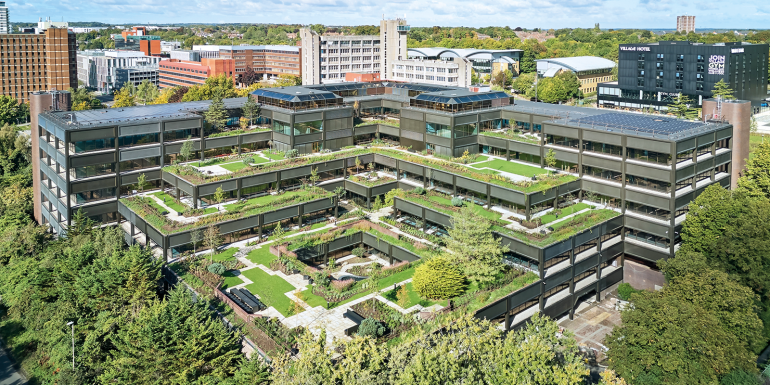
The retrofit and regeneration of celebrated 1970s modernist offices and gardens Mountbatten House to Plant Basingstoke is a story of forward-thinking biophilia to balance nature and the workplace.
Gateway House was originally designed in 1973 by Peter Foggo and Arup Associates Group 2 with garden designer James Russell for paper manufacturers Wiggins Teape. In the 1980s, IBM took it over as offices and its name changed to Mountbatten House. The stepped complex comprises six levels of commercial workspace blanketed in tiered roof gardens and terraces. Its purpose was to improve productivity by tapping into biophilia – that is, the inborn affinity humans have for the natural world.
Ian Taylor of Feilden Clegg Bradley Studios notes: “The building design’s prescience in creating contact with, and access to, nature within all the office spaces on all levels created a legacy that even now appears forward-thinking.”
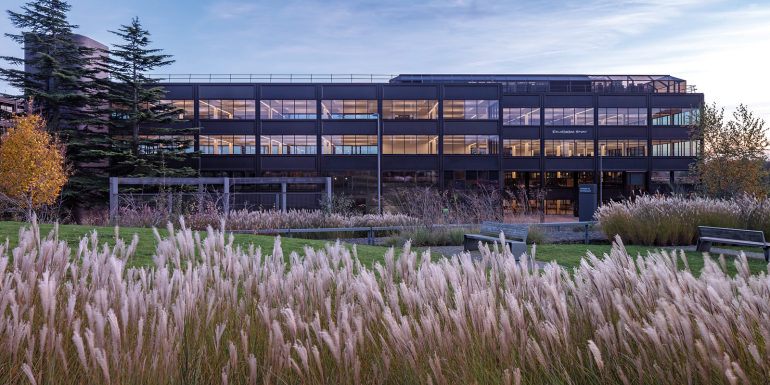
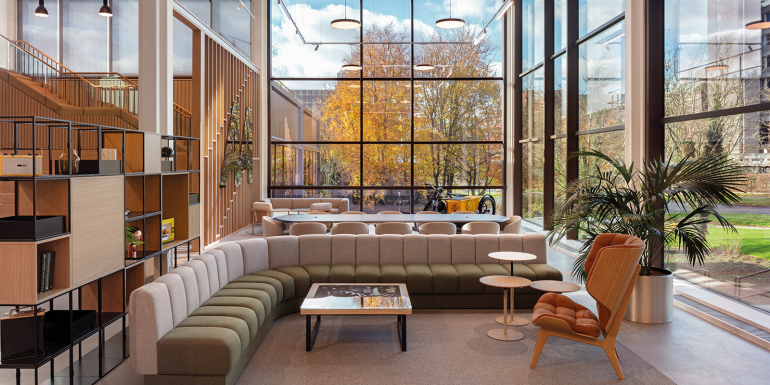
The gardens and building were both separately listed by English Heritage in 2015 for their design excellence and significance within British modernist architecture and horticulture. As a consequence, its retrofit has had to work within listed building parameters. These include a redesigned and expanded building entrance and reception area; the creation of double-height spaces to connect floors and increase natural light; and having suspended ceilings and finishes removed to reveal distinctive coffered slab structure and cruciform columns.
The original curtain wall system has been carefully refurbished, improving the building’s thermal performance. The mechanical, electrical and plumbing systems have been upgraded to enhance operational efficiency and future-proof the building, contributing to its ‘Outstanding’ BREEAM certification.
Planting for 2026
A key driver of the project was to improve access to the gardens and roof terraces, with new level access from all storeys. Research conducted in archives at the University of York – including Russell’s handwritten planting lists – has been adapted to be climate resilient. Species poorly suited to exposed rooftop conditions were replaced with those that enhance biodiversity. More than 22,500 new plants were introduced, along with 86 new trees to complement those already on the site.
With no raised planters across the gardens, adapting the planting required collaboration between the landscape architects, structural engineers and soil specialists, ensuring even loading across the multi-level structure. The renewed planting design draws inspiration from the original: to be informal, romantic, overflowing and tumbling.
Much of the existing hardscaping has been restored, with every original paving element across the garden levels recorded and catalogued, temporarily removed through construction and then replaced in-situ. Meanwhile a deteriorating pond has been replaced and renewed. Its current owner Mactaggart Family & Partners has engaged experts to fulfil the retrofit with the purpose of reinstating the buildings’ original intent: to blend nature, wellbeing and the workplace seamlessly. Its new life is as a new regional hub for growth – and, as office space goes, Plant is on another level.
Image credit | Andy Stagg | Andres Beasley
Related Content


Jobs

Permanent
Senior Quantity Surveyor- Civils/ Power
Permanent
Quantity Surveyor

Permanent
Assistant Quantity Surveyor
Permanent