

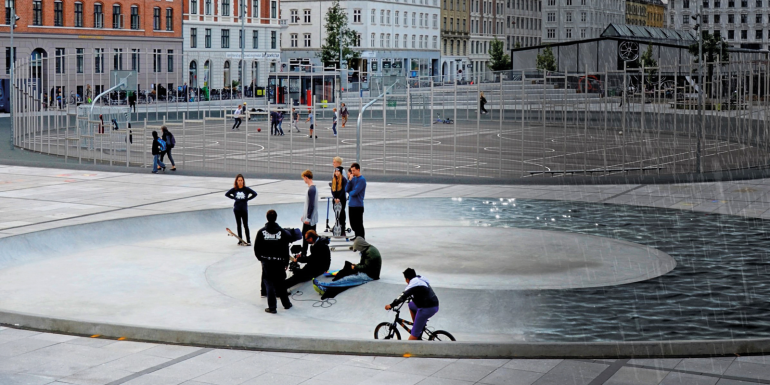
Copenhagen in Denmark is the world’s first true ‘Sponge City’ thanks to its innovative flood prevention measures.
Climate change means the significantly wetter weather is here to stay, but sustainable drainage measures don’t have to be dull, says Matt Lamy.
The most recent State of the UK Climate report – published in the Royal Meteorological Society’s International Journal of Climatology in July 2025 – highlighted two important factors concerning British weather. Firstly, the UK’s climate has warmed steadily from the 1980s onwards; secondly, as it has warmed, it has become wetter.
This increase in rainfall has been entirely due to an upward trend in the ‘winter half-year’ ie October to March. The average UK winter half-year in 2015-2024 was 16% wetter than the preceding 50 years, and October 2023 to March 2024 was the wettest winter half-year for England and Wales in more than 250 years.
One significant contributor is ‘extreme’ weather. For example, in September 2024, the Oxford Radcliffe Observatory recorded its wettest two-day period in almost 200 years. That September was also the wettest calendar month since 1774, with some locations recording three to four times the monthly average rainfall and several hundred properties flooded.
Then we come to the issue of choice of sites for housing developments. As the pressure for land increases, so choice is restricted. Written evidence submitted by Aviva to the UK Parliament Environmental Audit Committee’s Flood Resilience in England inquiry in October 2025 said: “One in 13 of all new homes built over the past decade [almost 110,000] have been in higher-risk flood areas and new homes are not built in a flood-resilient fashion.”
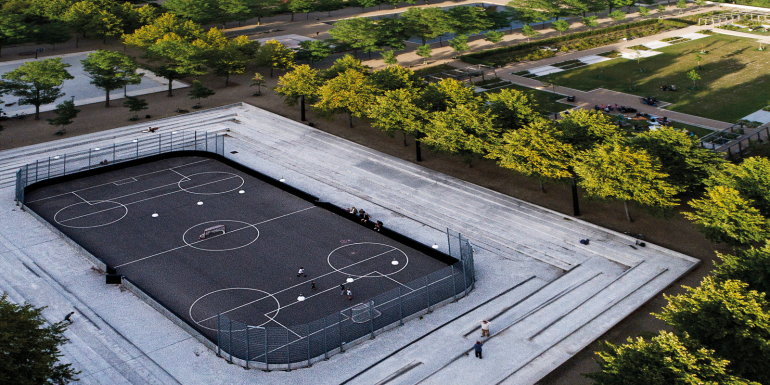
Copenhagen’s Enghave Park features an integrated underground reservoir with capacity for almost six million gallons.
UK statutory requirements
Against this backdrop, the need for effective sustainable drainage systems (SuDS) has never been greater, and this is reflected in the changing face of UK legislation.
In July 2025, the UK government released national standards for SuDS in England. These are based on 11 principles that take into account a natural approach to water management, early and integrated design, and links with development planning.
The seven standards themselves cover runoff destinations; management of everyday rainfall; management of extreme rainfall and flooding; water quality; amenity; biodiversity; and – most important for CABE members – design of drainage for construction, operation, maintenance, decommissioning and structural integrity.
Other UK nations have had their own measures in place for some time. Statutory standards for SuDS in Wales – incorporating six standards that largely reflect those that have subsequently been outlined for England – were published in 2018. In 2025, Natural Resources Wales released more detailed guidance around compliance.
In Scotland, standard 3.6 of the Building Standards Technical Handbook 2022: Domestic (published in June 2022) outlines the mandatory standard required for surface water drainage: “Every building, and hard surface within the curtilage of a building, must be designed and constructed with a surface water drainage system that will: a, ensure the disposal of surface water without threatening the building and the health and safety of the people in or around the building and; b, have facilities for the separation and removal of silt, grit and pollutants.”
In Northern Ireland, September 2025 saw the release of the Water, Sustainable Drainage and Flood Management Bill. This introduced new powers for the Department for Infrastructure around regulating SuDS use, design, construction and operation. “A SuDS approval body may be established to oversee implementation, fees and compliance. SuDS will be promoted as the preferred drainage solution in new developments,” it states.
But while standards and requirements are now set, there’s no reason why the form that SuDS take can’t be as creative and inspired as any other aspect of building design.
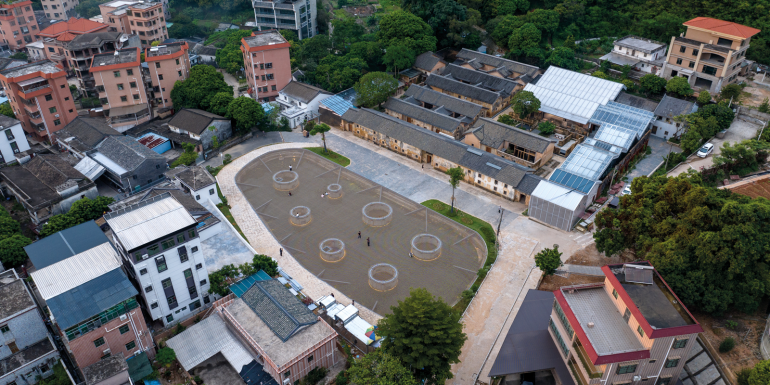
Copenhagen, Denmark, ‘Sponge City’
On July 2 2011, in the space of just two hours, Copenhagen was battered by more than five inches of torrential rain. Despite local authorities being acutely aware of the city’s low-lying nature and having – at the time – advanced sustainability measures in place, the flooding that ensued overwhelmed Copenhagen’s services and resulted in damage totalling $1.8bn.
Resolving to never let such a situation happen again, Copenhagen brought together architects, building engineers and urban planners to create the world’s first true ‘Sponge City’. By utilising a network of nature-based surface features combined with large underground pipeline and storage systems, the city is able to contain rising tides and stormwater before slowly releasing it back into the water cycle or directly into Copenhagen Harbour.
The network – the product of the ambitious Cloudburst Management Plan or ‘Skybrudsplan’ – incorporates 350 individual flood-mitigation projects. The most impressive from an engineering perspective are the extensive subterranean basins, pumping stations and massive underground pipelines that transport stormwater to treatment plants and then to the harbour. At present, two of the project’s subterranean ‘water highways’ have been completed – at a cost of $98m – with another currently in progress and the final fourth tunnel scheduled to begin construction later this year.
Other measures are easier to spot on the surface. Green spaces such as parks and gardens that filter and retain stormwater have been promoted and local lakes have been enlarged and ringed with wetlands to increase water storage capacity. Copenhagen’s historic 11-acre Enghave Park now features an integrated underground reservoir with capacity for almost six million gallons, which can be increased by a further 3.7 million gallons of surface storage thanks to concrete retaining walls guiding rainwater into the park.
One of the most successfully integrated components of the Cloudburst project is Karen Blixen’s Square – at nearly five acres, it is one of Copenhagen’s largest public spaces. In addition to the square’s own network of attractive pocket gardens, it features Tellytubby-like cast concrete dome hills, beneath which is parking for more than 2,000 bicycles. However, in the event of extreme rain, these structures can also retain stormwater, taking pressure off a nearby canal.
Other solutions are more subtle. A vacant strip of land on the street Scandiagade was transformed into a city garden with a butterfly garden, vegetable beds and benches. However, dotted among the flora are seven concrete basins, ready to accept heavy rainfall from the adjacent road, which itself has been altered slightly to direct run-off in an appropriate direction. From these basins, the water can either filter into the ground or be guided through underground channels to the harbour.
While still less than halfway complete, thanks to the measures already taken as part of the Cloudburst project, experts believe that Copenhagen’s flood risk in high-priority areas has been reduced by 30-50%.
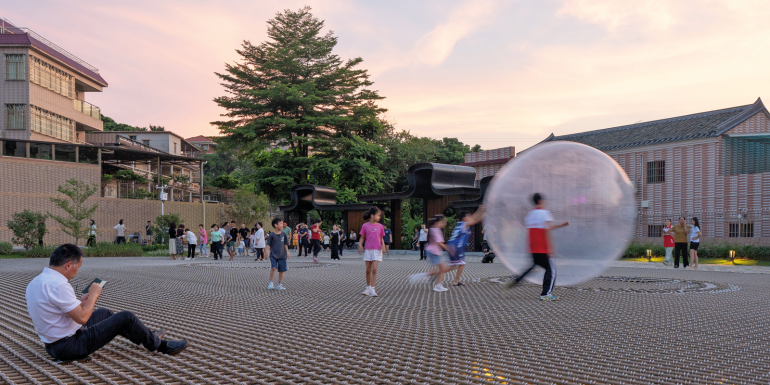
In Changshou Village in Shenzhen a new public space has been created on the mesh above, while the water body is retained below.
Changshou, China, ‘Soft Square’
Denmark might be leading the way as a ‘Sponge City’, but it was China that originally coined the term. However, not all of China’s water-focused projects are designed to accommodate unprecedented events and extreme waterfalls. Rather, some projects are designed to make better use of traditional, existing surface water bodies.
A prime example is the ‘Soft Square’ in Changshou Village, Shenzhen. Originally the site of Changshou’s historic fishpond – a feature deeply embedded in the cultural and social traditions of southern Chinese villages – the encroaching built environment meant that, over time, the area had ceased to be used. However, by covering the pond with an expansive rope mesh, a new public space has been created above, while the water body is retained below.
Designed by ZXD Architects and completed in December 2023, Changshou’s Soft Square was constructed using seven circular concrete support structures built into the pond. These structures have been designed and installed to shorten the span of unsupported rope netting. At the same time, in order to balance the horizontal tensile force of the rope netting on the side walls of the pond, multiple steel supports have been extended to the perimeter of the pond from the seven concrete support structures.
In terms of the rope netting itself, the distance between the centre lines of any two adjacent ropes is fixed at 120mm, which allows people of all ages to move safely and comfortably. In addition, the rope netting material has been built to be extremely resilient, with low ductility and a breaking tension of up to 90KN.
Underneath the uppermost, publicly accessible layer of rope netting, another rope net made of more slender material has been laid to prevent objects from falling. To access this, two openable entrances have been provided on the uppermost netting layer to allow daily maintenance.
ZXD Architects says that, although the rope netting is absolutely safe, its unique grid structure forces people to be careful and try to keep their balance so as not to inadvertently trigger the butterfly effect of swaying. “Because of the nature of the rope net, each step of another person is clearly transmitted and vice versa, and this experience constitutes a unique form of interaction that transforms passive perception into active participation.” It would seem that the community is encouraged to bounce.
And, of course, the presence of the rope netting does not affect the original function of the area, where the pond remains an integral part of the village water system.
FURTHER READING
- SuDS in England b.link/SuDS_England
- SuDS in Wales b.link/SuDS_Wales
- SuDS in Scotland b.link/SuDS_Scotland
- SuDS in Northern Ireland b.link/SuDS_NI
Image credit | State Of Green | ZXD Architects
Related Content

Jobs

Permanent
Senior Quantity Surveyor- Civils/ Power
Permanent
Quantity Surveyor

Permanent
Assistant Quantity Surveyor
Permanent