

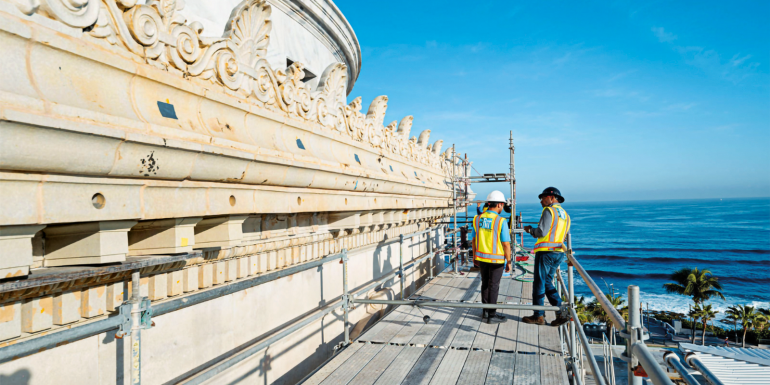
Conservation specialist Cintec details the restoration of the cornice and dome of the Capitol Building of Puerto Rico.
Construction of El Capitolio (the Capitol Building of Puerto Rico) began in 1925. The building contains two chambers, with the Senate on one side and the House of Representatives on the other. A vast marble staircase faces Ponce de León Avenue and gives access to the building to the south. The building also boasts an impressive rotunda, which extends upwards to the three floors of the building, and a decorative cornice that adorns the base of the dome.
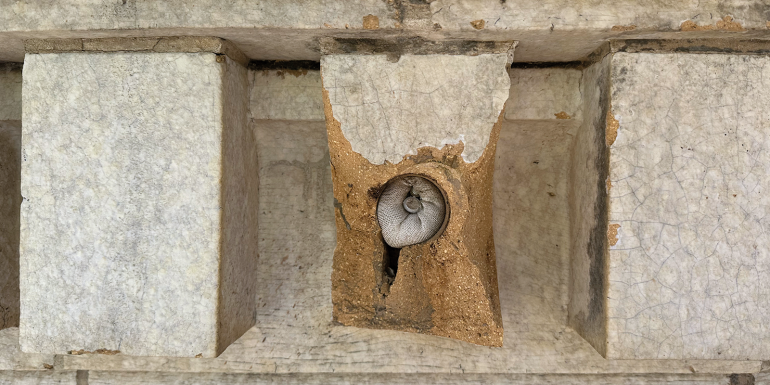
In 1998, an investigation revealed several major problems related to the ingress of large quantities of salt-laden moisture. The corrosion had been so severe that it was no longer possible to establish the exact dimensions of any of the former steel elements. Some had disappeared totally, leaving only rusty stains in the terracotta work. Severe cracking and movement of the corners were also evidence of a structural failure and deterioration.

For Cintec’s anchor system the façade was drilled and the metal anchors were inserted through the masonry.
Anchoring system
It was recommended that all heavily damaged and collapsing areas of the cornice be dismantled and rebuilt using new units from a well-established terracotta manufacturer. To retain as much original material as possible, it was also recommended that the undamaged but unstable areas of terracotta be stabilised in-situ.
This reinforcement involved Cintec’s anchor system – that is, a corrosion-resistant metal anchor encased in Presstec grout, a proprietary mix that provides adhesion and durability. The façade is drilled and the anchors are inserted, ensuring that the structural support is evenly distributed. This system is specifically engineered to enhance structures while avoiding any disruption to the original materials, which is particularly important for a building of architectural and historical significance.
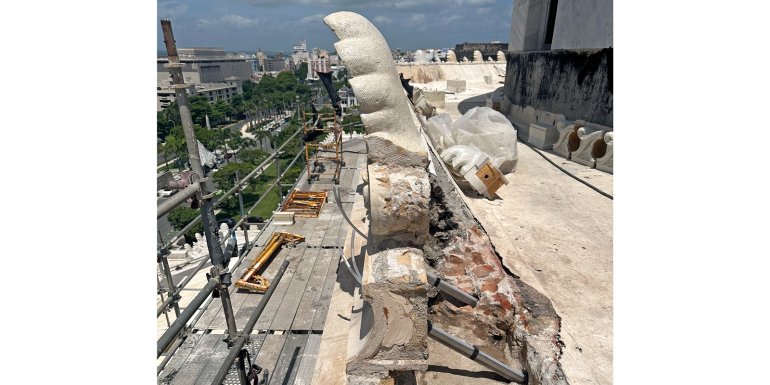
The approach of this restoration reflects a growing awareness of the need to protect and maintain architectural heritage while addressing contemporary structural challenges and atmospheric weathering.
Related Content

Jobs

Permanent
Senior Quantity Surveyor- Civils/ Power
Permanent
Quantity Surveyor

Permanent
Assistant Quantity Surveyor
Permanent