

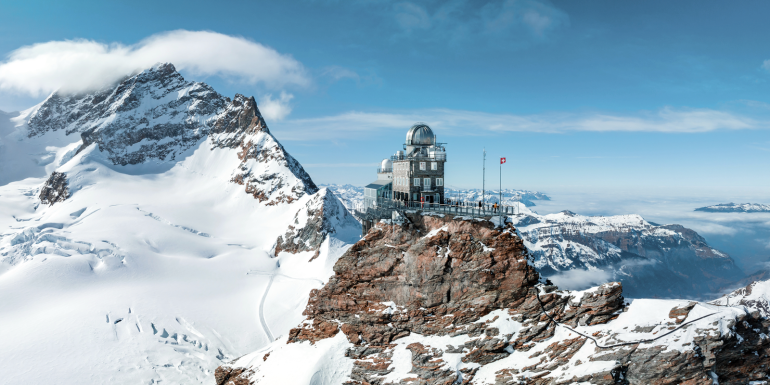
With temperatures dropping as low as -37°C and an altitude of nearly 3,600 metres, the Sphinx Observatory in the Swiss Alps gives new meaning to ‘working at height’.
Built on a mountain summit at 3,571 metres in Switzerland, the Sphinx Observatory is the highest research facility of its kind in Europe and one of the highest in the world. Here, scientists conduct atmospheric, astronomical and glaciological studies. Every day, researchers, laboratory staff and thousands of visitors depend on two Schindler elevators to access the observatory and its panoramic viewing deck.
When the facility first opened in 1937, visitors and scientists relied on a single lift. As tourism grew, journeys to the top became lengthy and long waits became the norm. In the 1990s, the original elevator was replaced with two modern Schindler elevators, dramatically improving efficiency and reliability. Recently, the twin elevators underwent a modernisation process.
The lifts travel upwards 108 metres in just 25 seconds. Above their shafts, carved inside the mountain rock, sit two massive machines, each weighing more than two tons, responsible for pulling the lift cars. In addition to the hardware modifications, the modernisation included lightning protection.
“We routed all individual wires from the control system, cabin and shaft through lightning protection elements,” explains Roger Zehr, Technical Project Lead at Schindler. “This made the assembly process far more complex. Normally, the hanging cable comes with finished connectors that simply plug in on both sides.”
At such high altitude and under extreme conditions, where temperatures often plunge to -37°C, the project demanded meticulous planning, innovative engineering and expert human oversight.
“We encountered all kinds of challenges in this project,” he explains. “All heavy parts and materials had to be transported by train and the motor was delivered to the machine room completely disassembled for easier transport. The altitude itself was a challenge, as it affects breathing and concentration and can cause headaches and dizziness. It was crucial for our team to acclimatise first and get proper rest to be able to work safely.”
Teamwork
Both the initial installation in the 1990s and the modernisation relied heavily on the partnership with the Jungfrau Railway, which was essential for transporting materials, parts and personnel to Jungfraujoch Station, Europe’s highest train station, located beneath the Sphinx Observatory. The Jungfrau Railway climbs 1,400 metres in just 30 minutes, running on a specially engineered track system designed to handle the extreme gradient.
Kurt Weber, a retired Schindler technician who worked on the installation of the lifts 30 years ago, recalls how crucial strong collaboration with the railway team was. “We exchanged phone numbers and I told them to call me any time if they needed anything, even on weekends. Once, one of them called me while I was on holiday in Egypt and I was able to help over the phone. He still reminds me of that today. It’s something special.”
For Zehr, that same spirit of collaboration continues to define the project. “The teamwork is unique in such a one-of-a-kind, hard-to-reach place.”
Related Content


Jobs

Permanent
Senior Quantity Surveyor- Civils/ Power
Permanent
Quantity Surveyor

Permanent
Assistant Quantity Surveyor
Permanent