

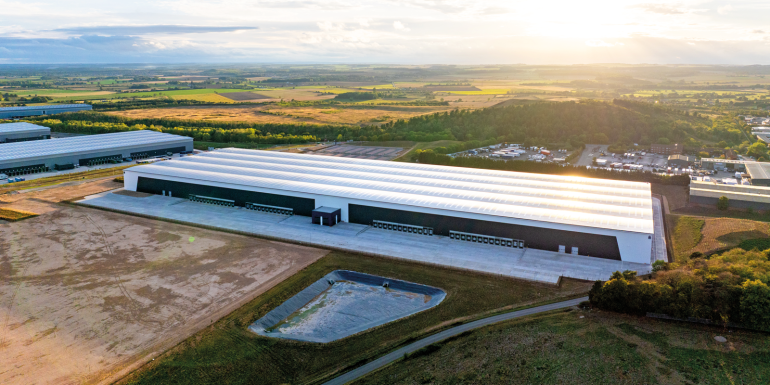
Panattoni Park in Doncaster features 817m2 of PV panels for on-site renewable energy generation
Between April and August 2025, the UK Net Zero Carbon Buildings Standard Pilot version was applied to 205 projects – here’s how the results have shaped Version 1 of the Standard.
While significant progress has been made in defining what ‘net zero’ means for buildings in the UK, a process of market analysis showed a clear demand for a single, agreed methodology. Consequently, there is a cross-industry initiative to develop the UK’s first Net Zero Carbon Buildings Standard, which will enable the industry to either fund, procure, design or specify a net-zero-carbon building, or to robustly prove their built assets are net zero carbon and in line with the UK’s climate targets.
In September 2024, the pilot version of the Standard was published and all buildings in the UK were invited to carry out pilot testing. Participants were also invited to include projects at various stages of development – from early design through to post construction. The projects submitted included both best-performing and typical representative buildings, even if these were not expected to meet the ambition of the Standard.
Pilot buildings included: King Charles III Sacristy at Westminster Abbey; Hamilton House, a Grade II Listed heritage office building for Dorrington; Lyde Green School for South Gloucestershire Council; Theatr Clwyd in Flintshire; Glyn-coch School in Rhondda Cynon Taf County; Postal Street Housing for Manchester City Council; and logistics hubs for Greenbox and Panattoni UK.
Pilot participants tested the process of applying the Standard to live buildings and projects, the usability and clarity of it in practice, and the industry’s level of readiness to adopt it.
Over four months, they took part in an in-depth technical survey and structured technical forums. Participants also had access to self-governing, peer-to-peer groups for knowledge-sharing and problem-solving. Amrita Dasgupta Shekhar, Head of ESG and Net Zero at Greengage Environmental, which ran the testing programme, says: “The pilot demonstrated that a single industry standard for defining and verifying net-zero carbon buildings is both necessary and workable in practice.”
Feedback from the pilot testing
Following the close of the testing in August, the feedback was analysed and collated into a detailed findings report and used to update the Standard – for example, newly-added annexes cover delineation, deeming to satisfy and an optional validity check at practical completion. The Standard’s section on verification has been updated to detail the process, as well as how users will be able to communicate their ‘net-zero-carbon aligned’ status.
The Version 1 update includes supporting resources: Guidance for Existing and Heritage Buildings, Guidance for the Legal Profession on How to Incorporate the Standard into Contracts, and further graphics and videos to support understanding and use.
Ellie Burkill, Chair of the Standard’s Technical Steering Group, says: “The pilot testing programme has been a hugely valuable step in the evolution of the UK Net Zero Carbon Buildings Standard. The real-life application of the Standard has given us practical insights that our Technical Steering Group is feeding directly into Version 1.”
Many of the pilot buildings’ experiences were enlightening. For example, Panattoni Park in Doncaster had achieved a BREEAM Outstanding rating and EPC A, with an upfront carbon target of less than 300kgCO2/m2 in line with the UKGBC Framework Definition (2019) and RICS Whole Life Carbon Assessment Professional Statement Edition 2. The 72,772m2 development boasts 817m2 of PV panels for on-site renewable energy generation and comprises a single-storey warehouse, a three-storey office and two two-storey hub offices. The external works include the service yard, roadways and car parking, which incorporates 30 electric vehicle charging spaces and 17 cycle shelters (accommodating 170 bicycles) to encourage low-carbon travel alternatives.
In monitoring the operational carbon data using BEMS, it recognised the building would not fully meet several key Standard requirements, including operational energy performance, fossil fuel elimination, integration with district heating and cooling networks, refrigerant management, delivered heating and cooling, on-site renewables, operational water use and overall electricity demand.
Theatr Clwyd is a mid-1970s arts complex undergoing an upgrade and reconfiguration. It used the pilot to identify upskilling needs and the need for a UKNZCBS co-ordinator or administrator role, much like a BREEAM AP or retrofit co-ordinator, to manage the verification process and ensure accountability of all relevant parties through the early stages into post occupancy. It also noted that the information was readily available because the project was ongoing and that, as a cautionary tale, information would be much harder to source if it is done retrospectively.
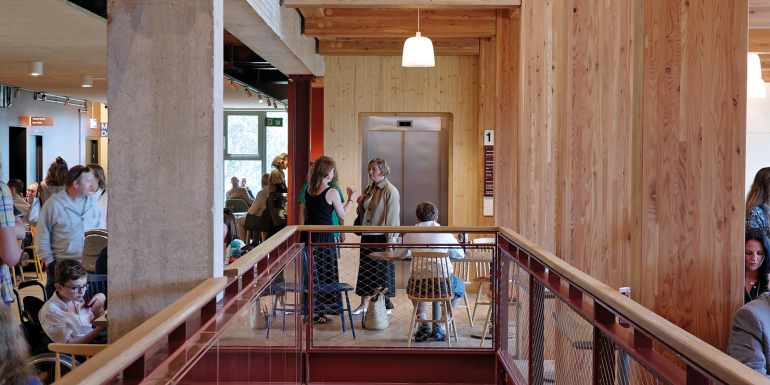
Theatr Clwyd in Flintshire used the pilot to identify its upskilling needs
Unexpected benefits
While the main aim of the testing was to collect detailed feedback on the process of applying the Standard to buildings, participants also reported wider benefits that they experienced from applying the Standard to their internal processes. These included measurable outcomes and understanding of how to achieve net-zero carbon buildings throughout the stages of a project. Application of the Standard also brought with it enhanced credibility and improved investor confidence, as well as better design and stronger collaboration.
Arun Thaneja, Technical Services & Sustainability Director at Winvic Construction, says: “Overall, the pilot testing experience has strengthened our understanding of how to align internal reporting with the Standard. We are now better equipped to generate project-level data that directly supports whole-life carbon reduction and operational efficiency targets. This has reinforced our commitment to embedding consistent, measurable processes across all projects.”
Other participants used the process as a benchmarking exercise to test their own processes and understanding of what net zero looks like. Hunter Lydon, Programme Manager of developer This City, says that they “found it invaluable to feedback our experience to date and to share knowledge between likeminded people within the pilot programme”.
He continues: “By joining, we wanted to understand how using an existing assessment standard compared to the pilot standard and to look back at how decisions we made through our own ‘best practice’ briefs compared. Application of the Standard in this way showed us the benefits of good design and strong collaboration within our projects, providing that much-needed assessment and guidance as we continue our journey towards net zero.”
Standard involvement
- Better Buildings Partnership (BBP)
- Building Research Establishment (BRE)
- The Carbon Trust
- Chartered Institution of Building Services Engineers (CIBSE)
- Institution of Structural Engineers (IStructE)
- LETI
- Royal Institute of British Architects (RIBA)
- Royal Institution of Chartered Surveyors (RICS)
- UK Green Building Council (UKGBC)
Version 1 is expected in early 2026 – to read more on the pilot version, visit nzcbuildings.co.uk
To read more on the pilot case studies, email [email protected]
Related Content


Jobs

Permanent
Senior Quantity Surveyor- Civils/ Power
Permanent
Quantity Surveyor

Permanent
Assistant Quantity Surveyor
Permanent