

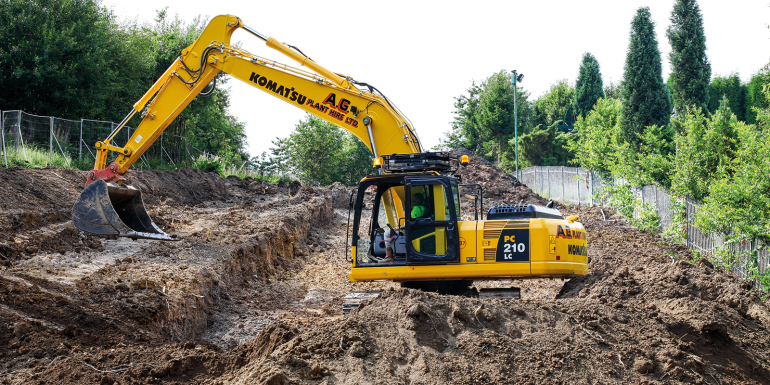
How can smart technology help alleviate the labour skills shortage? Bart Vingerhoets at Komatsu Smart Construction is glad you asked.
The opening statement of a McKinsey & Company report states that “construction is the largest industry in the global economy, accounting for 13% of the world’s GDP”. Yet, it has more than 36,000 vacancies recorded per quarter in the UK alone (according to Statista). As of 2024, the British Chambers of Commerce noted that 82% of UK construction and engineering firms reported difficulties in recruiting staff.
Governments recognise this impending shortfall and are prioritising the skills shortage in Europe, with policies setting new environmental targets. Estimates from the European Commission indicate that this could lead to the creation of between 1 million and 2.5 million additional jobs overall by 2030, but that only increases the need for a qualified workforce to handle increasing demand.
So, could smart technology be the answer? It’s fair to say the construction industry is behind the times in terms of digitisation. This, along with an ageing workforce, contributes to why many young workers don’t see its appeal. Additionally, there has been a dramatic fall in 16-30-year-olds entering the industry, meaning a less agile and a less digitally literate workforce at a time when the industry is trying to meet demand.
Smart working
According to PBC Today, over the next five years 95% of UK construction companies plan on investing in tech, with the hope of attracting new talent. There are multiple benefits to this, from upskilling the workforce and reducing the amount of time required at site to gather information and communicate changes to providing tracking data to the client that is easy to analyse and interpret.
Chris Horn, Technology Manager at HB Golf, says digital solutions have “allowed me to regain time previously lost to surveying and doing invoices. These are tasks my site managers can now pick up, upskilling the existing workforce and making them more versatile – especially at a time when it has been hard to find qualified managers.”
Digital solutions can also support practical elements of building. For example, Smart Construction’s machine guidance system enables excavator operators to dig with centimetre precision. The system provides instant feedback on the screen, which helps operators to reduce over-digging and rework. It also eliminates the need for extra surveying as operators can check the accuracy of their own work and visualise the finished product with the model on the screen. Adrian Binkert, owner of Binkert Baggerarbeiten in Switzerland, says the cost-effective solution means “the operator can work on-site alone, with no extra surveying work needed”.
As smart technology develops, it can act as a buffer for the some of the challenges the construction industry faces. From administrative efficiencies to precision guidance and monitoring systems, there are many ways it can help alleviate the labour skills shortage. It just needs the industry to give it a chance.
More information is available here.
Read about the investment to attract more workers.
Read the European Commission report here.
Image credit | Alamy
Related Content


Jobs

Permanent
Senior Quantity Surveyor- Civils/ Power
Permanent
Quantity Surveyor

Permanent
Assistant Quantity Surveyor
Permanent