

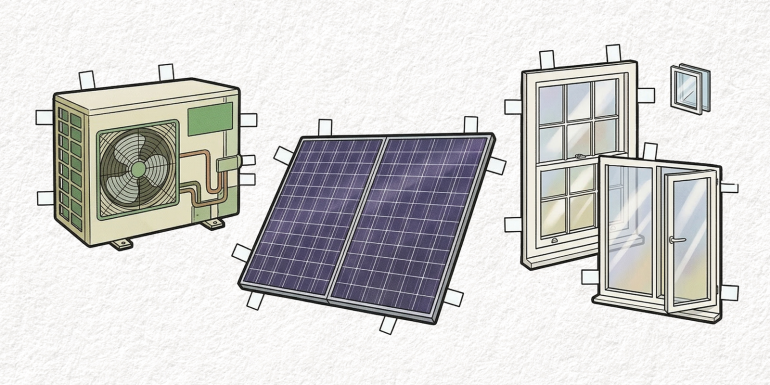
The Building Research Establishment’s Head of Research and Innovation Ed Suttie explores the regulatory hurdles stifling retrofit and built environment innovations in the UK.
Achieving net zero depends not just on how we build, but how we improve the homes we live in. This is particularly important at a time when at least 80% of buildings that will be occupied in 2050 have already been built, according to a 2025 House of Commons committee report, and the UK’s housing stock is among the least energy efficient in Europe.
Retrofitting existing buildings is therefore essential to meeting the UK government’s commitment to net zero – a challenge the industry is ready to respond to. However, innovation in this sector is often advancing faster than the systems designed to validate and approve them.
New technologies, products, services and materials are needed for retrofit projects, and there must be a clear path from idea to availability on the market.
The Building Research Establishment (BRE) has joined several industry partners (Constructing Excellence, the Construction Products Association, the National Energy Foundation, the National Retrofit Hub and Planet Mark) to launch RetroNetZero, an Innovate UK-funded Regulatory Science and Innovation Network. The network will analyse challenges that stakeholders encounter and where regulatory science has a solution. The BRE is working to help ensure that future regulation will support innovation and enable safe and consumer-protected products, materials and protocols.
This has taken shape through mapping the schemes and processes through which innovators bring a product to market. By pooling this resource into one location, we will improve transparency for innovators.
Demystifying retrofit
At present, the route to adoption for domestic retrofit innovation is often complex and unclear. There are many schemes and processes to be navigated by innovators looking to scale out their product, particularly when looking to tap into government-funded and supported retrofit programmes. These include potentially achieving recognition through initiatives such as the Microgeneration Certification Scheme, Product Characteristics Database or SAP Appendix Q process, as well as understanding Building Safety Regulator and Office for Product Safety and Standards demands.
Some products have specific requirements legally imposed by the UK’s Construction Products Regulations (CPR), while others rely on voluntary standards or self-declared performance data. Since leaving the EU, the UK has operated its own version of these regulations through the UKCA regime.
In January 2025, the EU updated its CPR framework to simplify what was regarded as an overly complex legal framework and ensure consistent implementation across member states. Crucially, the revised framework is closely aligned with broader EU sustainability initiatives like the Energy Performance of Buildings Directive, allowing construction products to directly support energy efficiency objectives and net-zero objectives.
This is in contrast to the UK, where alongside current and upcoming proposed changes to the UK CPR new retrofit technologies must navigate often-overlapping approval schemes and seemingly inconsistent requirements. It can pose a particular challenge given the drivers for domestic retrofit often involve government-funded schemes, which layer on additional indirect requirements on products and systems. Until now, there has been no single source of clarity on requirements for the sector.
Performance gap
RetroNetZero could be a useful reference source for performance claims when specifying a project alongside other resources, though it is not a current core aspiration. RetroNetZero is engaged with bodies linked to the pathways and certification (for products and systems) to understand the demands placed on innovators, and how standards and performance evaluation methods might need to evolve.
The performance gap in retrofit is important, and it cuts across several areas of the network’s activity. RetroNetZero is working with those involved in energy modelling, with the innovative technical solutions that can speed up and provide more accurate individual building heat loss calculations, and those developing the Home Energy Model for the Department for Energy Security and Net Zero.
Specific challenges emerging include gaps in certification for products deployed into retrofit, which includes the contribution to energy performance those products make, and the momentum and direction of travel towards the measured outcome of retrofit solutions (whole house) through increasingly accessible and cost-effective monitoring sensors and smart meters in homes.
RetroNetZero is working on certification gaps when deploying into retrofit, and linking this to unlocking delivery of retrofit at scale, building on the work in the Transform-ER project.
For more see b.link/Transform-ER
Laying a path
In response, the first steps at RetroNetZero have been to provide a bird’s-eye view of the current systems. It has consulted with both regulators and innovators to ensure a networked approach and allow clear pathways to adoption to be available for all.
Building on the extremely useful work of the Energy Systems Catapult’s Innovation Accelerator project, RetroNetZero has published detailed innovation adoption roadmaps showing the steps required to navigate various product approvals for retrofit.
The roadmaps distinguish between what is mandatory (necessitated by key market drivers) and what is voluntary to help innovators prioritise their efforts.
It has also created an online directory of organisations and facilities that could support companies through the required approvals processes – from testing laboratories and certification organisations to facilities offering product demonstration opportunities.
Often innovators do not know who to turn to to support their product journey. The RetroNetZero directory will help broker important connections for those new to the sector and unfamiliar with who can help provide evidence and recognition of performance claims.
The network partners’ next steps have been to explore where opportunities exist to streamline or help innovators to navigate these pathways, and work is ongoing in investigating a number of ‘challenge’ opportunities. These include identifying systematic issues with sizing heat pumps that could deter consumers from switching to such systems; exploring how the associated co-benefits of retrofit products could be better promoted through regulation; and providing supporting guidance on conducting field trials to demonstrate robust product performance for recognition processes such as SAP Appendix Q.
When innovators can’t see a clear route to adoption, promising ideas stall and retrofit delivery lags. The result is fewer low-carbon technologies in homes, and a growing gap between the UK and its European counterparts.
RetroNetZero is actively embedding regulatory science within the UK’s approach to retrofit. All partners want to ensure that innovators have a predictable path to market while maintaining the safety and quality of technology. That clarity is essential if the UK is to scale retrofit beyond pilot projects and turn technological progress into real, measurable carbon reductions.
For more, visit retronetzero.uk
See the updated EU CPR framework at b.link/RICS_CPR
Image credit | iStock| Gemini Generated Image
Related Content


Jobs

Permanent
Senior Quantity Surveyor- Civils/ Power
Permanent
Quantity Surveyor

Permanent
Assistant Quantity Surveyor
Permanent