

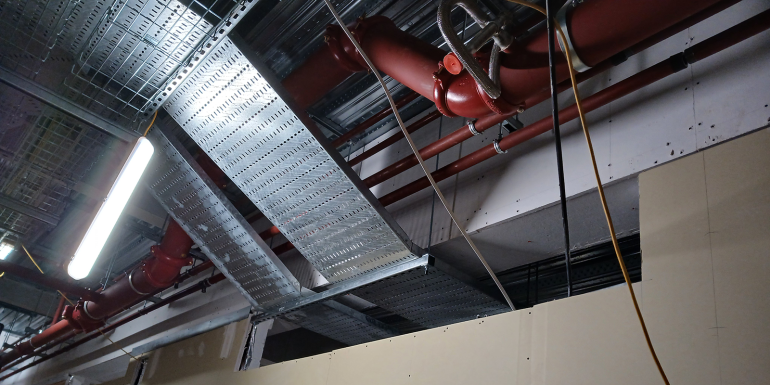
Services have been installed without allowance for fire stopping access and the fire-resisting steel encasement has been installed too close to the cable tray
Dean Mullen of Time Matters Fire Protection discusses a case study in cable tray co-ordination and compartmentation constraint.
This case study is based on my experience working on live construction sites within passive fire protection. It focuses on a single example involving a cable tray installation passing through a compartment line, in conditions where fire stopping could not be installed as a tested system.
The aim is to highlight how site co-ordination, service installation sequencing and restricted access conditions can directly affect whether passive fire protection systems can be implemented as intended under design and manufacturer requirements.
What this example shows is that the issue is not limited to installation quality, but to how services and compartment elements are co-ordinated during construction, and whether the conditions required for tested fire-stopping systems are maintained on-site.
This is an examination of installation conditions, observed during works involving a cable tray passing through a compartment wall at high level. It focuses on how the positioning of building services, in combination with adjacent fire protection systems and restricted access conditions, can create scenarios where fire-stopping systems cannot be installed in accordance with their tested parameters.
The purpose of this is to demonstrate that compartmentation performance is influenced not only by installation quality, but by the extent to which site conditions and construction sequencing maintain the requirements necessary for compliant fire-stopping installation. It reflects a recurring industry challenge, where passive fire protection systems are dependent on installation conditions that are not consistently preserved during the construction process. It also highlights the need for communication between all of the designers and contractors throughout.
Context
The works were carried out within a multi-use building where compartmentation was required to protect escape routes and maintain fire separation between functional areas, including plant and circulation zones.
The fire strategy relied on continuous compartment lines, with all service penetrations sealed using tested fire-stopping systems installed in accordance with manufacturer guidance.
On-site, I observed an installed cable tray passing through a compartment wall at high level. The tray was fully loaded with closely packed armoured cables and positioned extremely close to a structural steel beam that had already been protected using a single-layer fire-resisting board encasement system. This created a restricted installation zone where access around the penetration was significantly limited.
The key issue was not just the presence of the cable tray, but the combined interface between:
- the compartment wall penetration
- the loaded service tray; and
- the adjacent fire-resisting steel encasement.
This reduced the available working space required to install fire stopping correctly. Fire-stopping systems rely on specific installation conditions in order to perform as tested. These typically include:
- access to the penetration interface
- sufficient annular space around services
- ability to install materials to full depth and continuity; and
- installation within defined tested geometries.
In this case, those conditions were not present. The proximity of the cable tray to the fire-resisting steel encasement, combined with the density of services within the tray, significantly restricted access to the compartment line. As a result, the geometry of the installation did not align with standard tested fire-stopping configurations.
Even where a compliant system is specified, these physical constraints can prevent it from being installed in accordance with its tested parameters.
Compartmentation impact
Where fire stopping cannot be installed as tested, the integrity of the compartment line becomes dependent on compromised or non-standard conditions. The key risks in this scenario include:
- reduced effectiveness of fire and smoke separation
- loss of continuity at the compartment line
- increased reliance on unverified or adapted solutions; and
- apparent completion without tested compliance assurance.
This is particularly critical where compartmentation supports protected escape routes or separates higher-risk building zones.
Based on on-site conditions, the issue is not isolated to installation but relates to co-ordination and sequencing. The main contributing factors were:
- services installed without allowance for fire-stopping access
- lack of early co-ordination between service routing and compartmentation strategy
- fire-resisting steel encasement installed in close proximity without interface planning; and
- restricted installation conditions created before fire-stopping works commenced.
This resulted in a situation where fire stopping became difficult to implement within its tested requirements. This case demonstrates a common issue seen on-site: fire-stopping systems are often dependent on conditions that are not always preserved during construction sequencing.
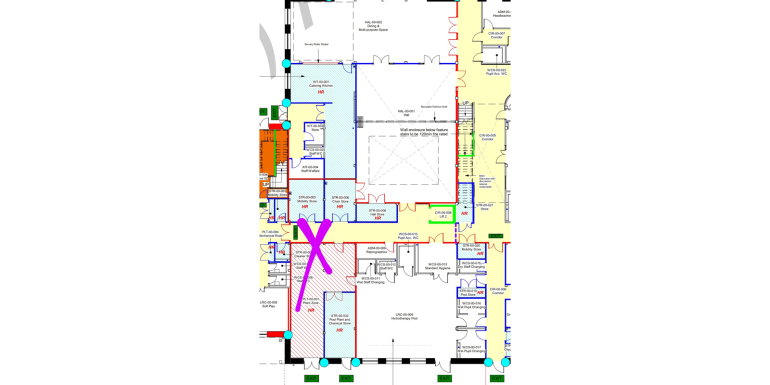
The location of the issue in relation to the floorplan and fire safety measures
Not in isolation
Fire stopping is not only a product-based system, but a geometry- and access-dependent installation. When services are installed in close proximity to other fire protection systems, such as steel encasement, the available working space can be reduced to the point where tested installation is no longer achievable. In practice, this shifts fire stopping from a controlled system installation to a reactive problem-solving exercise on-site. This case shows that passive fire protection performance is not determined solely by specification, but by whether installation conditions are maintained during construction.
It shows the significant issue that designers and contractors should be dealing with as they detail the design and build that design. The challenge is that this requires several disciplines to develop in parallel: the structural engineer needs to plan structure with the clearance required to accommodate the fire stopping; the building service engineer needs to plan space between services; the architect needs to allow space in the wall to accommodate the fire stopping; and the ‘fire engineer’ needs to define clearly the boundaries of compartments. Meanwhile, the builder and sub-contractors need to build to the design and ensure they maintain the space as planned. As these are all statutory duties under the Construction (Design and Management) Regulations and the Building Safety Act, it is a matter of communication at all levels. This will ensure each of the parties understands the need to accommodate each other’s requirements. The statutory nature of the requirements as well as the impact of failure needs to be understood.
Where service routing and adjacent fire protection systems restrict access or remove installation tolerances, fire-stopping systems cannot be installed as tested, creating a direct risk to compartmentation integrity. Improved co-ordination between service installation and fire-stopping requirements is essential to ensure that compartmentation systems remain both installable and compliant in practice.
For more information, contact Dean Mullen at uk.linkedin.com/in/dean-mullen-5610b23b1
Related Content

Jobs

Permanent
Building Surveyor / Residential Property Surveyor
Permanent
Building Surveyor / Residential Property Surveyor
Permanent
Senior Quantity Surveyor
Permanent